Advertisements
Advertisements
Question
A body is moving along a circular path of radius r. What will be the distance and displacement of the body when it completes:
Full revolution
Advertisements
Solution
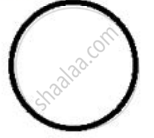
Distance travelled is =perimeter of circle.
So distance travelled is =2π r.
Displacement =0 as starting and ending point are coinciding.
APPEARS IN
RELATED QUESTIONS
State whether distance is a scalar or a vector quantity.
Differentiate between distance and displacement.
How is the distance related with time for motion under uniform acceleration such as the motion of a freely falling body?
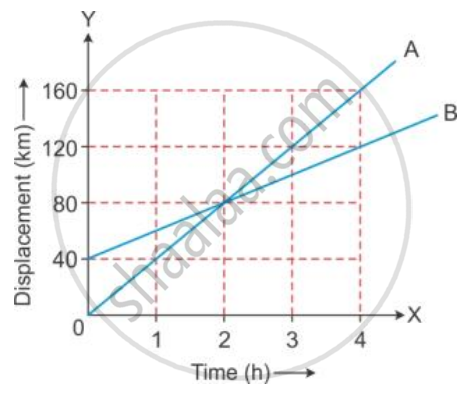
Figure ahead represents the displacement - time sketch of motion of two cars A and B . Find :
(i) the distance by which the car B was initially ahead of car A.
(ii) the velocities of car A and car B.
(iii) the time in which car A catches car B.
(iv) the distance from start when the car A will catch the car B.
Explain the following concept in your own words with everyday examples:
Distance
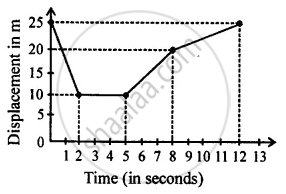
From the displacement – time graph shown given below calculate :
- Velocity between 0 – 2 s.
- Velocity between 8 s – 12 s.
- Average velocity between 5 s – 12 s.
The table below shows the distance travelled by two vehicles A and B during each second:
| Time (s) | 0 | 1 | 2 | 3 | 4 | 5 | 6 | 7 |
| Distance travelled by A (m) | 0 | 20 | 80 | 180 | 240 | 300 | 360 | 420 |
| Distance travelled by B (m) | 0 | 10 | 40 | 90 | 160 | 250 | 360 | 490 |
Which vehicle is moving with a constant acceleration?
Which of the following figures represent uniform motion of a moving object correctly?
Exercise Problems.
An athlete completes one round of a circular track of diameter 200 m in 40 s. What will be the distance covered and the displacement at the end of 2 m and 20 s?
Displacement can be zero but distance never.
