Advertisements
Advertisements
Question
Write an expression for the distance S covered in time t by a body which is initially at rest and starts moving with a constant acceleration a.
Advertisements
Solution
Distance = s, time = t, initial velocity u = 0 and acceleration = a.
Using the second equation of motion and substituting the above values we get,
s = ut + (1/2) at2
s = `1/2 "at"^2`
APPEARS IN
RELATED QUESTIONS
State whether distance is a scalar or a vector quantity.
What is the difference between distance travelled by a body and its displacement ? Explain with the
help of a diagram.
An ant travels a distance of 8 cm from P to Q and then moves a distance of 6 cm at right angles to PQ. Find its resultant displacement.
Can displacement-time sketch be parallel to the displacement axis? Give a reason to your answer.
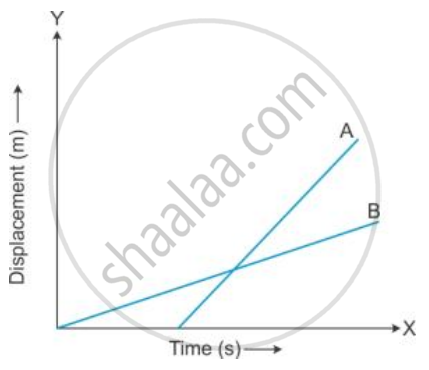
Figure shows the displacement-time graph of two vehicles A and B moving along a straight road. Which vehicle is moving faster? Give reason.
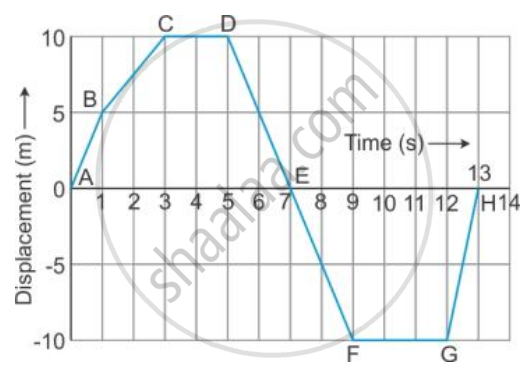
From the displacement-time graph of a cyclist given below in the Figure, find The displacement from the initial position at the end of 10 s,
Fill in the boxes.
| S.No | First Move | Seconde Move | Distance (m) | Displacement |
| 1. | Move 4 metres east | Move 2 metres west | 6 | 2 m east |
| 2. | Move 4 metres north | Move 2 metres south | ||
| 3. | Move 2 metres east | Move 4 metres west | ||
| 4. | Move 5 metres east | Move 5 metres west | ||
| 5. | Move 5 metres south | Move 2 metres north | ||
| 6. | Move 10 metres west | Move 3 metres east |
Which of the following is correct?
Four cars A, B, C, and D are moving on a levelled road. Their distance versus time graphs are shown in Fig. 8.2. Choose the correct statement.

If the displacement-time graph of a particle is parallel to the time axis, the velocity of the particle is ______.
