Advertisements
Advertisements
प्रश्न
Figure shows the velocity-time graph of a particle moving in a straight line.
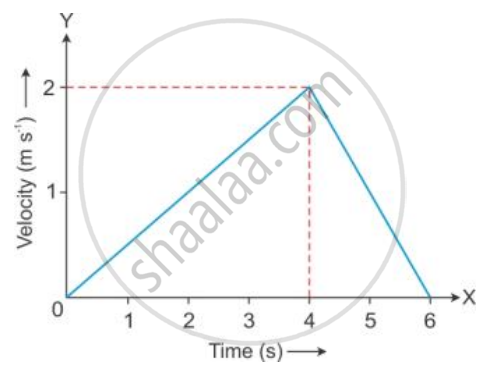
(i) State the nature of motion of particle.
(ii) Find the displacement of particle at t = 6 s.
(iii) Does the particle change its direction of motion?
(iv) Compare the distance travelled by the particle from 0 to 4 s and from 4 s to 6 s.
(v) Find the acceleration from 0 to 4 s and retardation from 4 s to 6 s.
Advertisements
उत्तर
(i) From 0 to 4 seconds, the motion is uniformly accelerated and from 4 to 6 seconds, the motion is uniformly retarded.
(ii) Displacement of the particle at 6 s = (1/2) (6) (2) = 6 m
(iii) The particle does not change its direction of motion.
(iv) Distance travelled by the particle from 0 to 4s (D1) = (1/2) (4) (2) = 4 m
Distance travelled by the particle from 4 to 6s (D2) = (1/2) (2) (2) = 2 m
D1:D2:: 4:2
D1:D2:: 2:1
(v) Acceleration from 0 to 4 s = (2/4) ms-2 or 0.5 ms-2
Retardation from 4 s to 6 s = (2/2) ms-2 or 1 ms-2.
APPEARS IN
संबंधित प्रश्न
A body is moving along a circular path of radius R. What will be the distance travelled and displacement of the body when it completes half a revolution ?
Clarify the difference.
Distance and displacement
Define displacement. State its unit.
Can displacement-time sketch be parallel to the displacement axis? Give a reason to your answer.
How can you find the following?
Velocity from a displacement – time graph.
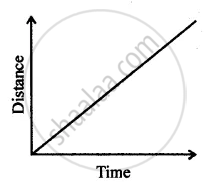
Can you suggest the kind of motion of a body from the following distance – time graph?
An object is thrown vertically upwards. It rises upto a height H and then returns to its initial position. Calculate
The total distance traveled by the object
Give the name of the physical quantity that corresponds to the rate of change of displacement.
Exercise Problems.
An athlete completes one round of a circular track of diameter 200 m in 40 s. What will be the distance covered and the displacement at the end of 2 m and 20 s?
A scalar quantity has ______.
