Advertisements
Advertisements
प्रश्न
Clarify the difference.
Distance and displacement
Advertisements
उत्तर
| Distance | Displacement |
| It is defined as the length of the actual path travelled by an object in motion. | It is defined as the shortest distance between the starting and finishing points. |
| It is a scalar quantity. | It is a vector quantity. |
| The values of distance are always positive. | The values of displacement can be positive, negative or zero. |
APPEARS IN
संबंधित प्रश्न
What is the difference between distance travelled by a body and its displacement ? Explain with the
help of a diagram.
If on a round trip you travel 6 km and then arrive back home :
What is your final displacement ?
A body travels a distance of 3 km towards East, then 4 km towards North and finally 9 km towards East.
What is the total distance travelled ?
When is the magnitude of displacement equal to the distance?
Can displacement-time sketch be parallel to the displacement axis? Give a reason to your answer.
How is the distance related with time for motion under uniform acceleration such as the motion of a freely falling body?
A body at rest is made to fall from the top of a tower. Its displacement at different instants is given in the following table:
| Time (in s) | 0.1 | 0.2 | 0.3 | 0.4 | 0.5 | 0.6 |
| Displacement (in m) | 0.05 | 0.20 | 0.45 | 0.80 | 1.25 | 1.80 |
Draw a displacement-time graph and state whether the motion is uniform or non-uniform?
A racehorse runs straight towards the north and covers 540 m in one minute. Calculate
- displacement of the horse,
- its velocity in (a) ms−1 (b) kmh−1.
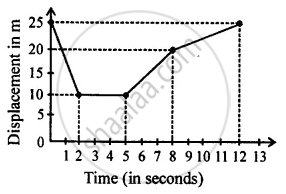
From the displacement – time graph shown given below calculate :
- Velocity between 0 – 2 s.
- Velocity between 8 s – 12 s.
- Average velocity between 5 s – 12 s.
A motorbike running at 90 kmh−1, is slowed down to 54 kmh−1 by the application of brakes, over a distance of 40 m. If the brakes are applied with the same force, calculate
- total time in which bike comes to rest
- total distance travelled by bike.
Under what condition is the displacement of a body equal to the distance traveled by it?
Write two differences between distance and displacement.
Calculate the distance and displacement in the following case: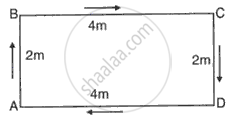
Calculate the distance and displacement in the following case: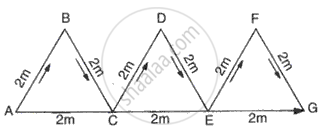
A satellite makes a complete round along its circular orbit. What is its displacement?
An object is thrown vertically upwards. It rises upto a height H and then returns to its initial position. Calculate
The total distance traveled by the object
Assertion: Displacement of a body may be zero when distance travelled by it is not zero.
Reason: The displacement is the shortest distance between initial and final position.
A man leaves his house at 6.30 a.m. for a morning walk and returns back at 7.30 a.m. after covering 4 km. The Displacement covered by him is ______.
Displacement can be zero but distance never.
