Advertisements
Advertisements
प्रश्न
How is the distance related with time for motion under uniform acceleration such as the motion of a freely falling body?
Advertisements
उत्तर
For motion under uniform acceleration, such as the motion of a freely falling body, distance is directly proportion to the square of the time.
APPEARS IN
संबंधित प्रश्न
Figure ahead represents the displacement - time sketch of motion of two cars A and B . Find :
(i) the distance by which the car B was initially ahead of car A.
(ii) the velocities of car A and car B.
(iii) the time in which car A catches car B.
(iv) the distance from start when the car A will catch the car B.
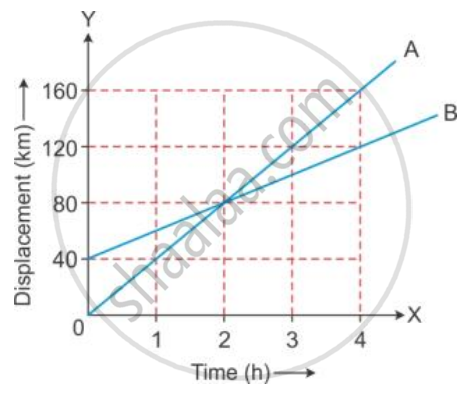
Figure shows the velocity-time graph of a particle moving in a straight line.
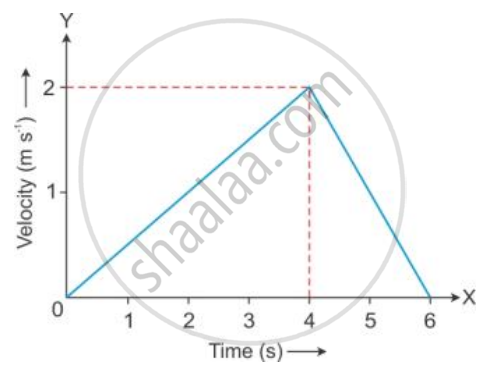
(i) State the nature of motion of particle.
(ii) Find the displacement of particle at t = 6 s.
(iii) Does the particle change its direction of motion?
(iv) Compare the distance travelled by the particle from 0 to 4 s and from 4 s to 6 s.
(v) Find the acceleration from 0 to 4 s and retardation from 4 s to 6 s.
A body starts from rest with uniform acceleration 2 m s-2. Find the distance covered by the body in 2 s.
When brakes are applied to a bus, retardation produced is 25 cm s-2 and the bus takes 20 s to stop. Calculate -
- The initial velocity of the bus
- The distance travelled by bus during this time.
Copy the following table and fill in the blank spaces.
| Quantity | S.I. Unit | Scalar or Vector |
| Displacement | ___________ | ___________ |
A body is moving along a circular path of radius r. What will be the distance and displacement of the body when it completes:
Half a revolution
A body is moving along a circular path of radius r. What will be the distance and displacement of the body when it completes:
Two full revolutions
An object is thrown vertically upwards. It rises upto a height H and then returns to its initial position. Calculate
The displacement of the object.
Choose the correct option.
Displacement magnitude can be greater than the distance traveled by the object.
