Advertisements
Advertisements
प्रश्न
In which of the following cases of motions, the distance moved and the magnitude of displacement are equal?
विकल्प
If the car is moving on a straight road
If the car is moving in a circular path
The pendulum is moving to and fro
The earth is revolving around the Sun
Advertisements
उत्तर
If the car is moving on a straight road
Expalantion:
If the car is moving on a straight road, the distance moved and the magnitude of displacement are equal.
APPEARS IN
संबंधित प्रश्न
A boy walks from his classroom to the bookshop along a straight corridor towards North. He covers a distance of 20 m in 25 seconds to reach the bookshop. After buying a book, he travels the same distance in the same time to reach back in the classroom. Find (a) average speed, and (b) average velocity, of the boy.
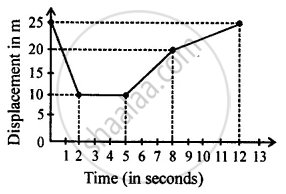
From the displacement – time graph shown given below calculate :
- Velocity between 0 – 2 s.
- Velocity between 8 s – 12 s.
- Average velocity between 5 s – 12 s.
Write the SI units for measurement of distance and displacement.
Calculate the distance and displacement in the following case: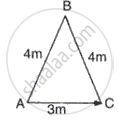
Fill in the boxes.
| S.No | First Move | Seconde Move | Distance (m) | Displacement |
| 1. | Move 4 metres east | Move 2 metres west | 6 | 2 m east |
| 2. | Move 4 metres north | Move 2 metres south | ||
| 3. | Move 2 metres east | Move 4 metres west | ||
| 4. | Move 5 metres east | Move 5 metres west | ||
| 5. | Move 5 metres south | Move 2 metres north | ||
| 6. | Move 10 metres west | Move 3 metres east |
The SI unit of displacement is ______.
A body is projected up with an initial velocity of u m/s. It goes up to a height, ‘h’ meters in seconds' time. Then it comes back at the point of projection.
Considering negligible air resistance, which of the following statement is true?
Distance travelled by a freely falling body is proportional to ______.
If the displacement-time graph of a particle is parallel to the time axis, the velocity of the particle is ______.
Displacement can be zero but distance never.
