Advertisements
Advertisements
प्रश्न
A body falls freely from a certain height. Show graphically the relation between the distance fallen and square of time. How will you determine g from this graph?
Advertisements
उत्तर

The value of acceleration due to gravity (g) can be obtained by doubling the slope of the S - t2 graph for a freely falling body.
संबंधित प्रश्न
A bullet initially moving with a velocity 20 m/s strikes a target and comes to rest after penetrating a distance 10 cm into the target. Calculate the retardation caused by the target.
A ball is rolling from A to D on a flat and smooth surface. Its speed is 2 cm/s. On reaching B, it was pushed continuously up to C. On reaching D from C, its speed had become 4 cm/s. It took 2 seconds for it to go from B to C. What is the acceleration of the ball as it goes from B to C?

Draw velocity – time graph for the following situation:
When a body is moving with variable velocity, but uniform retardation.
A racing car is moving with a velocity of 50 m/s. On
applying brakes, it is uniformly retarded and comes to rest in 20 seconds. Calculate its acceleration.
From the velocity – time graph given below, calculate deceleration in region BC.
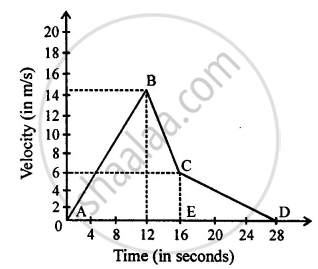
Diagram is given below shows velocity – time graph of car P and Q, starting from the same place and in the same direction. Calculate the Acceleration of car P.
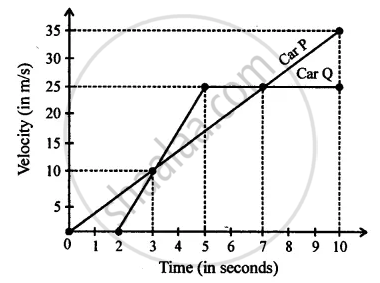
Write the SI unit of retardation.
Out of energy and acceleration, which one is a vector?
The graph shows how the velocity of a scooter varies with time in 50 s.
Work out: Deceleration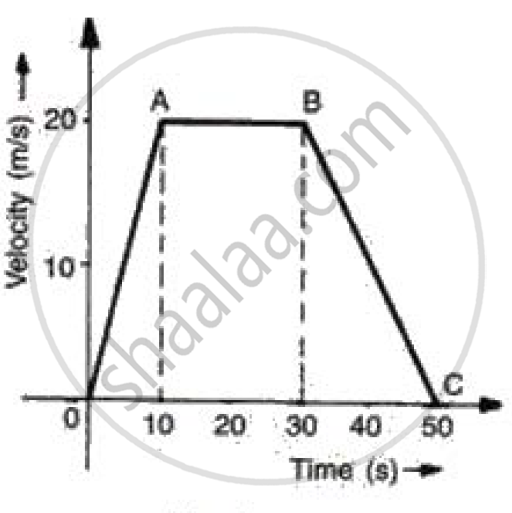
Assertion: When a body is subjected to a uniform acceleration, it is always moving in a straight line.
Reason: Motion may be straight-line motion or circular motion.
