Advertisements
Advertisements
प्रश्न
Write three equations of uniformly accelerated motion relating the initial velocity (u), final velocity (v), time (t), acceleration (a) and displacement (S).
Advertisements
उत्तर
Three equations of a uniformly accelerated motion are
v = u + at
s = ut + (1/2)at2
v2 = u2 + 2as
APPEARS IN
संबंधित प्रश्न
Fill in the following blank with suitable word :
Velocity is the rate of change of……………………… It is measured in.............. .
Name the quantity which is measured by the area occupied under the velocity-time graph.
Derive the formula s= `ut+1/2at^2` , where the symbols have usual meanings.
Differentiate between uniform acceleration and variable acceleration.
Derive the following equations for uniformly accelerated motion:
(i) v = u + at
(ii) `"S = ut" + 1/2 "at"^2`
(iii) v2 = u2 + 2aS
where the symbols have their usual meanings.
How can you find the following?
Acceleration from velocity – time graph.
Can you suggest a real-life example about the motion of a body from the following velocity – time graph?
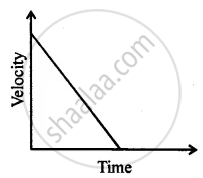
A packet is dropped from a stationary helicopter, hovering at a height ‘h’ from ground level, reaches the ground in 12s. Calculate
- the value of h
- final velocity of packet on reaching the ground. (Take g = 9.8 ms−2)
A stone thrown vertically upwards takes 3 s to attain maximum height. Calculate
- initial velocity of the stone
- maximum height attained by the stone. (Take g = 9.8 ms−2)
Draw a velocity versus time graph of a stone thrown vertically upwards and then coming downwards after attaining the maximum height.
