Advertisements
Advertisements
प्रश्न
Two stones are thrown vertically upwards simultaneously with their initial velocities u1 and u2 respectively. Prove that the heights reached by them would be in the ratio of `"u"_1^2 : "u"_2^2` (Assume upward acceleration is –g and downward acceleration to be +g)
Advertisements
उत्तर
At the highest point, v = 0
For the sone thrown with velocity u1
`0 - "u"_1^2 = 2(-"g')h_1` (Using v2 − u2 = 2s)
or `"h"_1 = ("u"_1^2)/(2"g")`
Similarly for the stone thrown with velocity u2,
`"h"_2 = ("u"_2^2)/(2"g")`
∴ The required ratio, `"h"_1/"h"_2 = ("u"_1^2)/(2"g") xx (2"g")/("u"_2^2) = ("u"_1^2)/("u"_2^2)`
APPEARS IN
संबंधित प्रश्न
Fill in the following blank with suitable word :
Velocity is the rate of change of……………………… It is measured in.............. .
Derive the formula : v = u + at, where the symbols have usual meanings.
A train starting from stationary position and moving with uniform acceleration attains a speed of 36 km per hour in 10 minutes. Find its acceleration.
A car is travelling along the road at 8 ms-1. It accelerates at 1 ms-2 for a distance of 18 m. How fast is it then travelling ?
When a car driver travelling at a speed of 10 m/s applies brakes and brings the car to rest in 20 s, then retardation will be :
A bicycle initially moving with a velocity 5.0 m s-1 accelerates for 5 s at a rate of 2 m s-2. What will be its final velocity?
When is the positive acceleration?
A stone thrown vertically upwards takes 3 s to attain maximum height. Calculate
- initial velocity of the stone
- maximum height attained by the stone. (Take g = 9.8 ms−2)
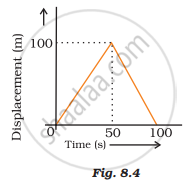
A girl walks along a straight path to drop a letter in the letterbox and comes back to her initial position. Her displacement–time graph is shown in Fig.8.4. Plot a velocity-time graph for the same.
An object starting from rest travels 20 m in the first 2 s and 160 m in the next 4 s. What will be the velocity after 7 s from the start?
