Advertisements
Advertisements
प्रश्न
Write three equations of uniformly accelerated motion relating the initial velocity (u), final velocity (v), time (t), acceleration (a) and displacement (S).
Advertisements
उत्तर
Three equations of a uniformly accelerated motion are
v = u + at
s = ut + (1/2)at2
v2 = u2 + 2as
APPEARS IN
संबंधित प्रश्न
Fill in the following blank with a suitable word:
Acceleration is the rate of change of ______ It is measured in ______
Find the initial velocity of a car which is stopped in 10 seconds by applying brakes. The retardation due to brakes is 2.5 m/s2.
A motorcycle moving with a speed of 5 m/s is subjected to an acceleration of 0.2 m/s2. Calculate the speed of the motorcycle after 10 seconds, and the distance travelled in this time.
A car is travelling along the road at 8 ms-1. It accelerates at 1 ms-2 for a distance of 18 m. How fast is it then travelling ?
Which of the following could not be a unit of acceleration?
A bicycle initially moving with a velocity 5.0 m s-1 accelerates for 5 s at a rate of 2 m s-2. What will be its final velocity?
Can you suggest a real-life example about the motion of a body from the following velocity – time graph?
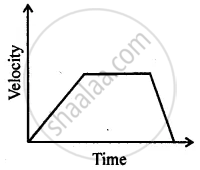
How will the equations of motion for an object moving with a uniform velocity change?
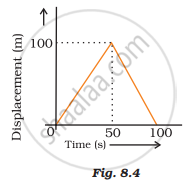
A girl walks along a straight path to drop a letter in the letterbox and comes back to her initial position. Her displacement–time graph is shown in Fig.8.4. Plot a velocity-time graph for the same.
An electron moving with a velocity of 5 × 10⁴ ms−1 enters into a uniform electric field and acquires a uniform acceleration of 104 ms–2 in the direction of its initial motion.
(i) Calculate the time in which the electron would acquire a velocity double of its initial velocity.
(ii) How much distance the electron would cover at this time?
