Advertisements
Advertisements
प्रश्न
A bus increases its speed from 36 km/h to 72 km/h in 10 seconds. Its acceleration is :
पर्याय
5 m/s2
2 m/s2
3.6 m/s2
1 m/s2
Advertisements
उत्तर
1 m/s2
Final velocity is = 72 km/h = 20 m/s
Initial velocity is = 36 km/h = 10 m/s
Time taken is 10 sec. so,
Acceleration = `(20-10)/10`
= 1 m/s2
So, the answer is
(d) 1 m/s2
APPEARS IN
संबंधित प्रश्न
A bus decreases its speed from 80 km h−1 to 60 km h−1 in 5 s. Find the acceleration of the bus.
A train starting from a railway station and moving with uniform acceleration attains a speed 40 km h−1 in 10 minutes. Find its acceleration.
Which of the two can be zero under certain conditions : average speed of a moving body or average velocity of a moving body ?
A body starting from rest travels with uniform acceleration. If it travels 100 m in 5 s, what is the value of acceleration ?
Define velocity. State its unit.
For a uniformly retarded motion, the velocity-time graph is _____________
Write three equations of uniformly accelerated motion relating the initial velocity (u), final velocity (v), time (t), acceleration (a) and displacement (S).
A body, initially at rest, starts moving with a constant acceleration 2 m s-2. Calculate: (i) the velocity acquired and (ii) the distance travelled in 5 s.
When is the positive acceleration?
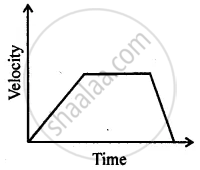
Can you suggest a real-life example about the motion of a body from the following velocity – time graph?