Advertisements
Advertisements
प्रश्न
Derive the following equation of motion by the graphical method : v2 = u2 + 2as, where the symbols have their usual meanings.
Advertisements
उत्तर
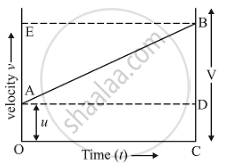
In the given figure, the distance travelled (s) by a body in time (t) is given by the area of the figure OABC which is a trapezium.
Distance travelld = Area of the trapezium OABC
So, Area of trapezium OABC,
= `"(Sum of parallel sides)(Height)"/2`
=`"(OA+CB)(OC)"/2`
Now, (OA + CB) = u + v and (OC) = t.
Putting these values in the above relation, we get:
`s = ((u+v)/2)t` ....(1)
Eliminate t from the above equation. This can be done by obtaining the value of t from the first equation of motion.
v = u + at
So,
`t = "v-u"/a`
Now, put this value of t in equation (1), we get:
`s = (((u+v)(v-u))/(2a))`
On further simplification,
2as = v2 – u2
Finally the third equation of motion.
`v^2 = u^2 + 2as`
where
(s) - Displacement
(u) - Initial velocity
(a) - Acceleration
(v) - Final velocity
(t) - Time taken
APPEARS IN
संबंधित प्रश्न
What does the slope of a speed-time graph indicate ?
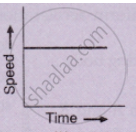
What type of motion is represented by the following graph ?
Draw velocity – time graph for the following situation:
When a body is moving with variable velocity, but uniform acceleration.
Diagram is given below shows velocity – time graph of car P and Q, starting from the same place and in the same direction. Calculate which car is ahead after 10 s and by how much?
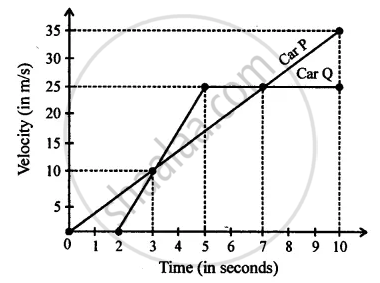
The area under a speed-time graph in a given intervals gives the total distance covered by a body irrespective of its motion being uniform or non-uniform.
Which of the following graphs represents a motion with negative acceleration?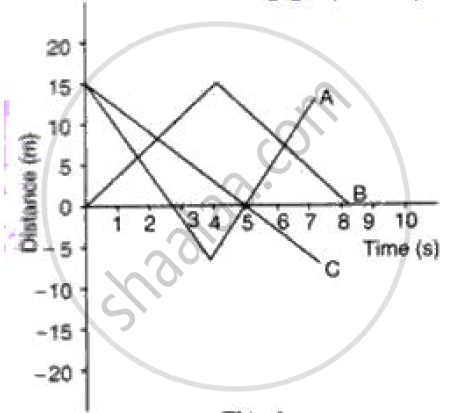
Sketch the shape of the velocity-time graph for a body moving with:
Uniformly velocity
Figure shows the distance-time graph of three students A, B and C. On the basis of the graph, answer the following :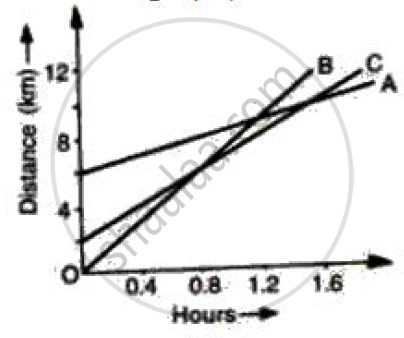
Will the three ever meet at any point on the road?
Figure shows the distance-time graph of three students A, B and C. On the basis of the graph, answer the following :
How far did B travel between the time he passed C and A?
Mention the uses of the velocity-time graph.
