Advertisements
Advertisements
प्रश्न
The area under velocity – time graph represents the ______
पर्याय
velocity of the moving object.
displacement covered by the moving object.
speed of the moving object.
acceleration of the moving object
Advertisements
उत्तर
The area under velocity – time graph represents the displacement covered by the moving object.
Explanation:
The area under a velocity-time graph represents the displacement of the moving object. This is because:
Displacement = Velocity × Time
In a velocity-time graph, the product of velocity and time is graphically represented by the area under the curve.
APPEARS IN
संबंधित प्रश्न
The velocity-time graph for part of a train journey is a horizontal straight line. What does this tell you about its acceleration ?
What can you say about the motion of a body if:
its displacement-time graph is a straight line ?
The speed-time graph of an ascending passenger lift is given alongside. What is the acceleration of the lift:
(1) during the first two seconds ?
(2) between second and tenth second ?
(3) during the last two seconds ?
Three speed-time graphs are given below :
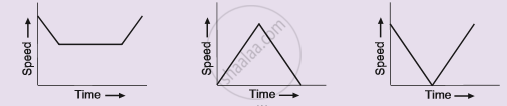
Which graph represents the case of:
(i) a cricket ball thrown vertically upwards and returning to the hands of the thrower ?
(ii) a trolley decelerating to a constant speed and then accelerating uniformly ?
Draw displacement – time graph for the following situation:
When a body is stationary.
A train starting from rest picks up a speed of 20 ms−1 in 200 s. It continues to move at the same rate for the next 500 s and is then brought to rest in another 100 s.
- Plot a speed-time graph.
- From graph calculate
(a) uniform rate of acceleration
(b) uniform rate of retardation
(c) total distance covered before stopping
(d) average speed.
Name the physical quantity which is equal to the area under speed-time graph.
Which of the following graphs represents a motion with negative acceleration?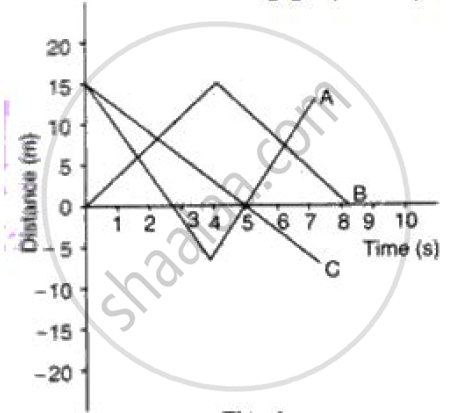
What can you say about the nature of motion of a body of its displacement-time graph is:
A straight line parallel to line axis?
Derive the equation
S = ut+ `1/2` at2
Using a speed- time graph
