Advertisements
Advertisements
प्रश्न
Figure shows the velocity-time graphs for two objects A and B moving in same direction . Which object has the greater a cceleration?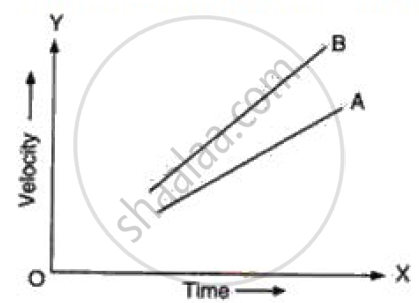
Advertisements
उत्तर
As acceleration is the slope of line in velocity time graph and as B has greater slope than line A.
So B has greater acceleration than A.
APPEARS IN
संबंधित प्रश्न
What can you say about the motion of a body if its speed-time graph is a straight line parallel to the time axis ?
The velocity-time graph for part of a train journey is a horizontal straight line. What does this tell you about the trains velocity.
Show by using the graphical method that: `s=ut+1/2at^2` where the symbols have their usual meanings.
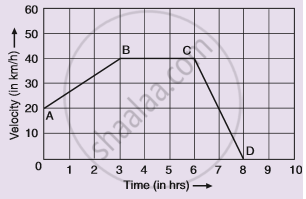
Given alongside is the velocity-time graph for a moving body :
Find :
(i) Velocity of the body at point C.
(ii) Acceleration acting on the body between A and B.
(iii) Acceleration acting on the body between B and C.
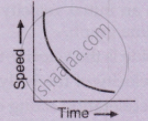
What type of motion is represented by the following graph ?
Draw displacement – time graph for the following situation:
When a body is stationary.
Name the physical quantity which is equal to the area under speed-time graph.
How will you use a speed-time graph to find whether the acceleration of the body is uniform or not?
The graph of one quantity versus another result in a straight line. How are the quantities related to each other?
Draw the following graph:
Speed versus time for a uniformly retarded motion.
