Advertisements
Advertisements
प्रश्न
Show by using the graphical method that: `s=ut+1/2at^2` where the symbols have their usual meanings.
Advertisements
उत्तर
Suppose the body travels a distance (s) in time (t).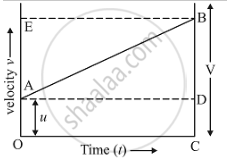
In the figure, the distance travelled by the body is given by the area of the space between the velocity-time graph AB and the time axis OC, which is equal to the area of the figure OABC.
Thus: Distance travelled = Area of the trapezium OABC
But, Area of the figure OABC = Area of rectangle OADC + Area of triangle ABD
= Area of rectangle OADC + area of triangle ABD
Now, find out the area of rectangle OADC and area of triangle ABD.
(i) Area of rectangle OADC
= (OA) (OC)
= (u) (t)
(ii) Area of triangle ABD,
= (1/2)(AD)(BD)
= (1/2)(t)(at)
= (1/2)at2
Distance travelled (s) is,
So, s = Area of rectangle OADC + Area of triangle ABD
`s = ut + 1/2at^2`
This is the second equation of motion.
Where
(s) - Displacement
(u) - Initial velocity
(a) - Acceleration
(t) - Time
APPEARS IN
संबंधित प्रश्न
Multiple choice Question. Select the correct option.
A graph is a straight line parallel to the time axis in a distance-time graph. From the graph, it implies:
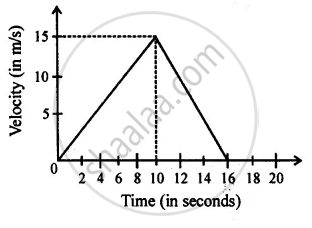
From the diagram given below, calculate distance covered by body.
Represent the position of a body described as at 15 m, 30o north of west, on a graph paper.
Draw the speed-time graph of a body when its initial speed is not zero and the speed increases uniformly with time.
Sketch the shape of the velocity-time graph for a body moving with:
Uniformly velocity
Figure shows the distance-time graph of three students A, B and C. On the basis of the graph, answer the following :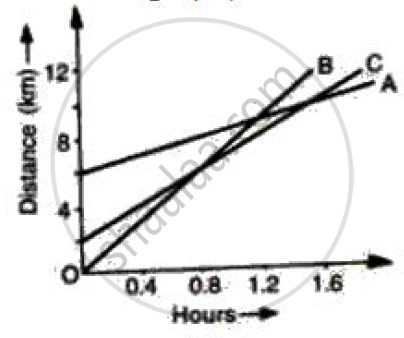
When B meets A, where is C?
The slope of the speed–time graph gives ______.
Saphira moves at a constant speed in the same direction. Rephrase the same sentence in fewer words using concepts related to motion.
The area under the v-t graph represents a physical quantity that has the unit.
Slope of the velocity-time graph gives ______.
