Advertisements
Advertisements
प्रश्न
Show by using the graphical method that: `s=ut+1/2at^2` where the symbols have their usual meanings.
Advertisements
उत्तर
Suppose the body travels a distance (s) in time (t).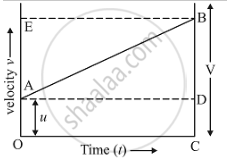
In the figure, the distance travelled by the body is given by the area of the space between the velocity-time graph AB and the time axis OC, which is equal to the area of the figure OABC.
Thus: Distance travelled = Area of the trapezium OABC
But, Area of the figure OABC = Area of rectangle OADC + Area of triangle ABD
= Area of rectangle OADC + area of triangle ABD
Now, find out the area of rectangle OADC and area of triangle ABD.
(i) Area of rectangle OADC
= (OA) (OC)
= (u) (t)
(ii) Area of triangle ABD,
= (1/2)(AD)(BD)
= (1/2)(t)(at)
= (1/2)at2
Distance travelled (s) is,
So, s = Area of rectangle OADC + Area of triangle ABD
`s = ut + 1/2at^2`
This is the second equation of motion.
Where
(s) - Displacement
(u) - Initial velocity
(a) - Acceleration
(t) - Time
APPEARS IN
संबंधित प्रश्न
What does the slope of a displacement-time graph represent?
What does the slope of velocity-time graph represent?
Draw velocity – time graph for the following situation:
When a body is moving with variable velocity, but uniform acceleration.
Diagram shows a velocity – time graph for a car starting from rest. The graph has three sections AB, BC, and CD.
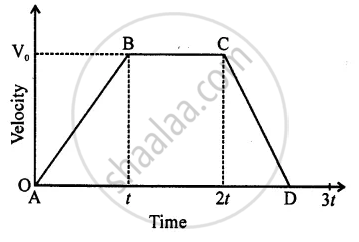
In which section, car has a zero acceleration?
Draw the speed-time graph of a body starting from some point P, gradually picking up speed, then running at a uniform speed and finally slowing down to stop at some point Q.
Interpret the following graph: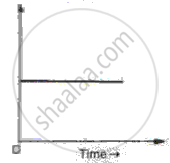
Given below are the speed -time graphs. Match them with their corresponding motions :
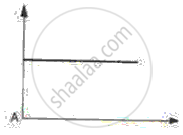 |
(a) Uniformity retared motion |
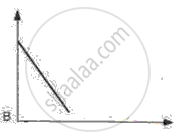 |
(b) Non-uniformity acceleration |
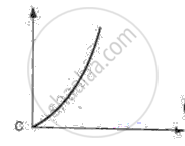 |
(c) Non-uniform motion |
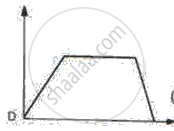 |
(d) uniform motion |
State whether true or false. If false, correct the statement.
The velocity – time graph of a particle falling freely under gravity would be a straight line parallel to the x axis.
Mention the uses of the velocity-time graph.
Which of the following can determine the acceleration of a moving object.
