Advertisements
Advertisements
प्रश्न
The speed-time graph of an ascending passenger lift is given alongside. What is the acceleration of the lift:
(1) during the first two seconds ?
(2) between second and tenth second ?
(3) during the last two seconds ?
Advertisements
उत्तर
(i) We have to find the acceleration from the given graph.
Acceleration = slope of line AB
= `((4.6-0))/((2-0)) "m/s"^2`
= 2.3 `"m/s"^2`
(ii) Between second and tenth second, it represents uniform speed, so, acceleration acting on the lift is zero.
(iii) During the last two seconds, it represents retardation of the lift, so its acceleration is (–2.3 m/s2).
APPEARS IN
संबंधित प्रश्न
Three speed-time graphs are given below :
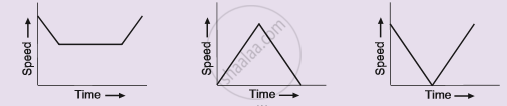
Which graph represents the case of:
(i) a cricket ball thrown vertically upwards and returning to the hands of the thrower ?
(ii) a trolley decelerating to a constant speed and then accelerating uniformly ?
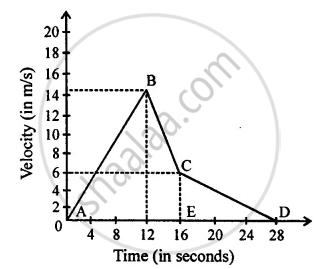
From the velocity – time graph given below, calculate Distance covered in the region ABCE.
Represent the position of a body described as at 15 m, 30o north of west, on a graph paper.
Draw the speed-time graph of a body starting from some point P, gradually picking up speed, then running at a uniform speed and finally slowing down to stop at some point Q.
What can you conclude if the speed-time graph of a body is a curve moving upwards starting from the origin?
Draw the following graph:
Speed versus time for a non-uniform acceleration.
Figure shows displacement- time graph of two objects A and B moving in a stra ight line. Which object is moving fa ster?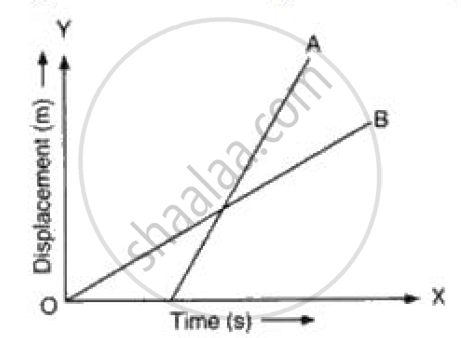
What can you say about the nature of motion of a body of its displacement-time graph is:
A straight line inclined to the time axis with an acute angle?
Draw distance-time graph to show:
Decreasing velocity
Derive the equation
S = ut+ `1/2` at2
Using a speed- time graph
