Advertisements
Advertisements
प्रश्न
Abdul, while driving to school, computes the average speed for his trip to be 20 km h−1. On his return trip along the same route, there is less traffic and the average speed is 30 km h−1. What is the average speed for Abdul’s trip?
Advertisements
उत्तर
Let the school be at a distance of x km. If
t1 is the time taken to reach the school, then
`t_1 = "distance"/"average speed" = x/20`
If t2 is the time taken to reach back, then
`t_2 = "distance"/"average speed" = x/30`
Total time,
t = `t_1 + t_2`
= `x/20 + x/30 `
= `x [1/20 + 1/30]`
= `(5x)/60`
= `x/12`
Total distance x + x = 2x
Average speed = `"total distance"/"total time"`
= `(2x)/(x/12)`
= 24 km h-1
संबंधित प्रश्न
During an experiment, a signal from a spaceship reached the ground station in five minutes. What was the distance of the spaceship from the ground station? The signal travels at the speed of light, that is, 3 × 10⁸m s−1.
What is the SI unit of retardation ?
A snail covers a distance of 100 metres in 50 hours. Calculate the average speed of snail in km/h.
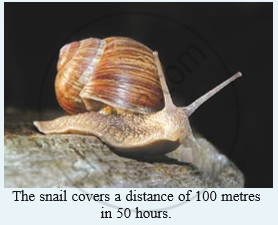
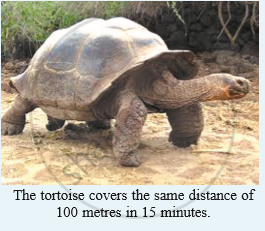
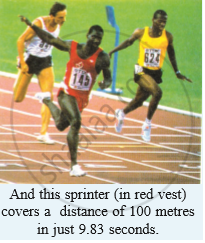
A car is moving along a straight road at a steady speed. It travels 150 m in 5 seconds:
What is its average speed ?
A ball hits a wall horizontally at 6.0 m s-1. It rebounds horizontally at 4.4 m s-1. The ball is in contact with the wall for 0.040 s. What is the acceleration of the ball ?
Which of the quantity-velocity or acceleration-determines the direction of motion?
For the motion with uniform velocity , how is the distance travelled related to the time ?
The velocity-time graph of a moving body is given below in Figure
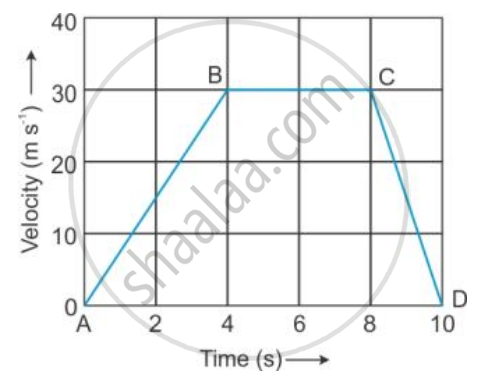
Displacement in each part AB, BC and CD.
A body projected vertically up with a velocity of 10 m/s reaches a height of 20 m. If it is projected with a velocity of 20 m/s, then the maximum height reached by the body is:
Derive th e equation of motion.
S = ut+ `1/2` at2,
Where the symbols have their usual meanings
