Advertisements
Advertisements
प्रश्न
A freely falling object travels 4.9 m in 1st second, 14.7 m in 2 nd second, 24.5 m in 3rd second, and so on. This data shows that the motion of a freely falling object is a case of :
पर्याय
uniform motion
uniform acceleration
no acceleration
uniform velocity
Advertisements
उत्तर
uniform acceleration
The displacement of the body in equal interval of time is unequal, but acceleration is constant. The acceleration will thus be uniform, so the answer is (b).
APPEARS IN
संबंधित प्रश्न
When will you say a body is at non-uniform acceleration?
Which of the two can be zero under certain conditions : average speed of a moving body or average velocity of a moving body ?
Fill in the following blank with suitable word :
Velocity is the rate of change of……………………… It is measured in.............. .
A car acquire a velocity of 72 km per hour in 10 second starting from rest. Find
(1) the acceleration,
(2) the average velocity, and
(3) the distance travelled in this time.
When a car driver travelling at a speed of 10 m/s applies brakes and brings the car to rest in 20 s, then retardation will be :
The slope of a speed-time graph gives:
Differentiate between uniform acceleration and variable acceleration.
How can you find the following?
Acceleration from velocity – time graph.
Can you suggest a real-life example about the motion of a body from the following velocity – time graph?
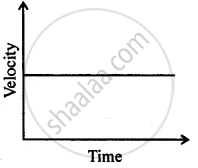
How will the equations of motion for an object moving with a uniform velocity change?
