Advertisements
Advertisements
प्रश्न
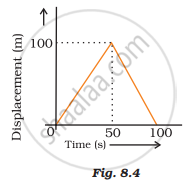
A girl walks along a straight path to drop a letter in the letterbox and comes back to her initial position. Her displacement–time graph is shown in Fig.8.4. Plot a velocity-time graph for the same.
Advertisements
उत्तर
From displacement – time graph,
velocity = `"displacement"/"time"`
= `(100"m")/(50"s")`
= 2ms−1
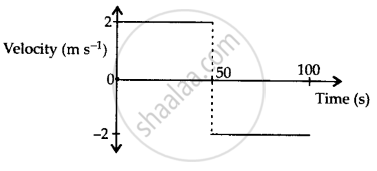
The symmetry of the graph shows that the girl comes back to her initial position with the same velocity (2 ms−1) but in opposite direction. So, the velocity-time graph will look like
APPEARS IN
संबंधित प्रश्न
What is meant by the term acceleration ? State the SI unit of acceleration.
Explain why, the motion of a body which is moving with constant speed in a circular path is said to be accelerated.
Describe the motion of a body which is accelerating at a constant rate of 10 m s–2. If the body starts from rest, how much distance will it cover in 2 s ?
A bus increases its speed from 36 km/h to 72 km/h in 10 seconds. Its acceleration is :
Differentiate between uniform acceleration and variable acceleration.
What do you understand by the term acceleration?
When is the negative acceleration?
Multiple choice Question. Select the correct option.
The speed of a car reduces from 15 m/s to 5 m/s over a displacement of 10 m. The uniform acceleration of the car is :
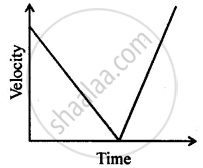
Can you suggest a real-life example about the motion of a body from the following velocity – time graph?
A stone thrown vertically upwards takes 3 s to attain maximum height. Calculate
- initial velocity of the stone
- maximum height attained by the stone. (Take g = 9.8 ms−2)
