Advertisements
Advertisements
प्रश्न
Which of the two can be zero under certain conditions : average speed of a moving body or average velocity of a moving body ?
Advertisements
उत्तर
Average velocity of a moving body can be zero. This is because the net displacement for a given time interval can be Zero .
APPEARS IN
संबंधित प्रश्न
When will you say a body is at non-uniform acceleration?
Fill in the following blank with suitable word :
Velocity is the rate of change of……………………… It is measured in.............. .
What is meant by the term acceleration ? State the SI unit of acceleration.
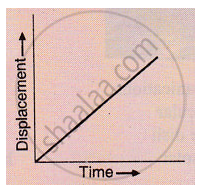
What conclusion can you draw about the velocity of a body from the displacement-time graph shown below :
A motorcycle moving with a speed of 5 m/s is subjected to an acceleration of 0.2 m/s2. Calculate the speed of the motorcycle after 10 seconds, and the distance travelled in this time.
Define velocity. State its unit.
The velocity-time graph of a body in motion is a straight line inclined to the time axis. The correct statement is ___________
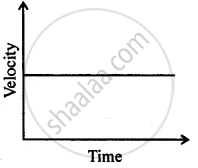
Can you suggest a real-life example about the motion of a body from the following velocity – time graph?
A stone thrown vertically upwards takes 3 s to attain maximum height. Calculate
- initial velocity of the stone
- maximum height attained by the stone. (Take g = 9.8 ms−2)
An object starting from rest travels 20 m in the first 2 s and 160 m in the next 4 s. What will be the velocity after 7 s from the start?
