Advertisements
Advertisements
प्रश्न
A bus decreases its speed from 80 km h−1 to 60 km h−1 in 5 s. Find the acceleration of the bus.
Advertisements
उत्तर
Initial velocity = 80km/h
= 80 × 100060 × 60
= 22.22 m/s
Time = 5s
Final velocity v = 60 km/h
= 60 × 100060 × 60
= 16.66 m/s
Acceleration = `"Change in velocity"/"Time taken"`
= `"(Final velocity - Initial velocity)"/"Time taken"`
= `(16.66-22.22 )/5`
= -1.11ms-2
Hence, acceleration of the bus = -1.11ms-2
APPEARS IN
संबंधित प्रश्न
What term is used to denote the change of velocity with time ?
If a stone and a pencil are dropped simultaneously in vacuum from the top of a tower, then which of the two will reach the ground first? Give reason.
For a uniformly retarded motion, the velocity-time graph is _____________
A body, initially at rest, starts moving with a constant acceleration 2 m s-2. Calculate: (i) the velocity acquired and (ii) the distance travelled in 5 s.
How will the equations of motion for an object moving with a uniform velocity change?
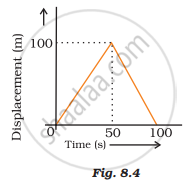
A girl walks along a straight path to drop a letter in the letterbox and comes back to her initial position. Her displacement–time graph is shown in Fig.8.4. Plot a velocity-time graph for the same.
The velocity-time graph (Fig. 8.5) shows the motion of a cyclist. Find (i) its acceleration (ii) its velocity and (iii) the distance covered by the cyclist in 15 seconds.

An object starting from rest travels 20 m in the first 2 s and 160 m in the next 4 s. What will be the velocity after 7 s from the start?
Two stones are thrown vertically upwards simultaneously with their initial velocities u1 and u2 respectively. Prove that the heights reached by them would be in the ratio of `"u"_1^2 : "u"_2^2` (Assume upward acceleration is –g and downward acceleration to be +g)
When will you say a body is at uniform acceleration?
