Advertisements
Advertisements
प्रश्न
A particle moves along a circular path. How many times does it change its direction in two complete rounds?
Advertisements
उत्तर
As in circular motion direction changes continuously with motion so after two complete revolutions we can say that direction has changed infinite times.
APPEARS IN
संबंधित प्रश्न
The numerical ratio of displacement to distance for a moving object is :
Figure (a) shows the velocity-time graph for the motion of a body. Use it to find the displacement of the body at t = 1 s, 2 s, 3 s and 4 s, then draw on Figure (b), the displacement-time graph for it.
 |
 |
| (a) | (b) |
Calculate the distance and displacement in the following case: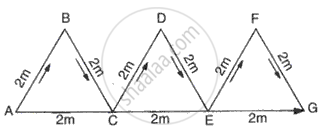
Give the name of the physical quantity that corresponds to the rate of change of displacement.
Is distance covered during nth second more than the distance covered in n seconds?
The table below shows the distance travelled by two vehicles A and B during each second:
| Time (s) | 0 | 1 | 2 | 3 | 4 | 5 | 6 | 7 |
| Distance travelled by A (m) | 0 | 20 | 80 | 180 | 240 | 300 | 360 | 420 |
| Distance travelled by B (m) | 0 | 10 | 40 | 90 | 160 | 250 | 360 | 490 |
At what time do A and B meet?Which vehicle is moving with a constant acceleration?
Exercise Problems.
An athlete completes one round of a circular track of diameter 200 m in 40 s. What will be the distance covered and the displacement at the end of 2 m and 20 s?
The SI unit of displacement is ______.
The displacement is zero when the initial and final positions are ______.
Assertion: If the displacement of the body is zero, the distance covered by it may not be zero.
Reason: Displacement is a vector & distance is a scalar quantity.
