Advertisements
Advertisements
Question
A body moves along a circular path of radius r. When it completes three complete rounds, what is the ratio of distance covered to its displacement?
Advertisements
Solution
As after completing 3 revolution in circular motion the displacement is = 0.
so the ratio of distance covered to the displacement is infinite.
APPEARS IN
RELATED QUESTIONS
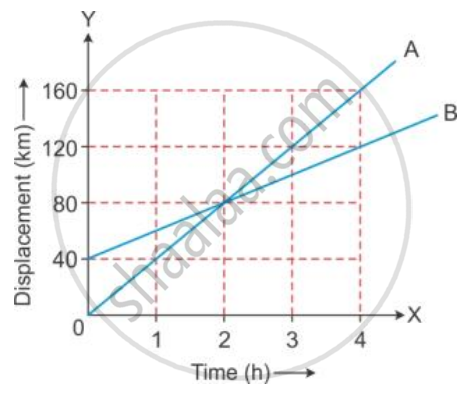
Figure ahead represents the displacement - time sketch of motion of two cars A and B . Find :
(i) the distance by which the car B was initially ahead of car A.
(ii) the velocities of car A and car B.
(iii) the time in which car A catches car B.
(iv) the distance from start when the car A will catch the car B.
A car starting from rest accelerates uniformly to acquire a speed 20 km h-1 in 30 min. The distance travelled by a car in this time interval will be _____________
A body starts from rest with uniform acceleration 2 m s-2. Find the distance covered by the body in 2 s.
A car covers 90 km in `1 1/2` hours towards east. Calculate
- displacement of car,
- its velocity in (a) kmh−1 (b) ms−1.
A motor car slows down from 72 kmh−1 to 36 kmh−1 over a distance of 25 m. If the brakes are applied with the same force
calculate
- total time in which car comes to rest
- distance travelled by it.
Write the SI units for measurement of distance and displacement.
Write two differences between distance and displacement.
Four cars A, B, C, and D are moving on a levelled road. Their distance versus time graphs are shown in Fig. 8.2. Choose the correct statement.

The SI unit of displacement is ______.
Slope of a velocity-time graph gives
