Advertisements
Advertisements
प्रश्न
Is it possible for an accelerating body to have constant speed?
Advertisements
उत्तर
No a accelerating body cannot have constant speed.
APPEARS IN
संबंधित प्रश्न
A toy car initially moving with uniform velocity of 18 km h-1 comes to a stop in 2 s. Find the retardation of the car in S.I. units.
A body falls freely from a certain height. Show graphically the relation between the distance fallen and square of time. How will you determine g from this graph?
From the diagram given below, calculate deceleration.
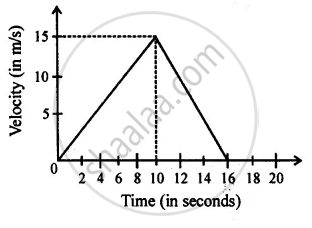
A body falls towards the earth. Does it have positive or negative acceleration?
Can you use the relation [B1]?
A car accelerates to a velocity of 30 m/s in 10 s and then decelerates for 20 s so that it stops. Draw a velocity-time graph to represent the motion and find:
Distance travelled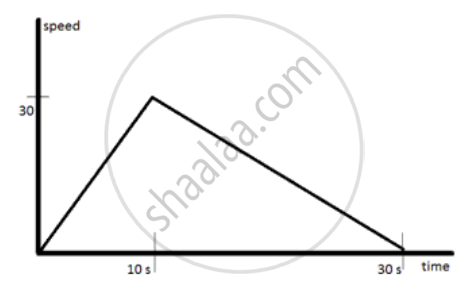
State whether true or false. If false, correct the statement.
Acceleration can get negative value also.
If the velocity of a body does not change, then its acceleration is ______.
Acceleration is a scalar.
Assertion: When a body is subjected to a uniform acceleration, it is always moving in a straight line.
Reason: Motion may be straight-line motion or circular motion.
