Advertisements
Advertisements
प्रश्न
From the given v-t graph it can be inferred that an object is

विकल्प
in uniform motion
at rest
in non - uniform motion
moving with uniform accelerations
Advertisements
उत्तर
moving with uniform accelerations
APPEARS IN
संबंधित प्रश्न
The unit of retardation is ____________
A body is moving vertically upwards. Its velocity changes at a constant rate from 50 m s−1 to 20 m s−1 in 3 s. What is its acceleration?
State the type of motion represented by the following sketches in Figures.
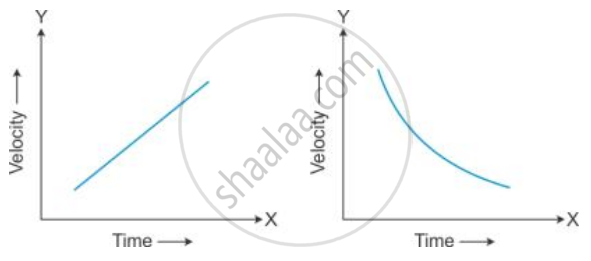
Give an example of each type of motion.
A car travels with uniform velocity of 25 m s-1 for 5 s. The brakes are then applied and the car is uniformly retarded and comes to rest in further 10 s. Find:
- The distance which the car travels before the brakes are applied,
- Retardation and
- The distance travelled by car after applying the brakes.
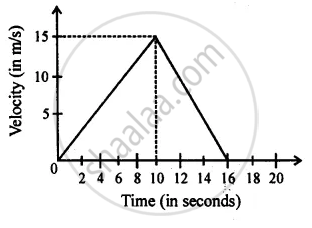
From the diagram given below, calculate deceleration.
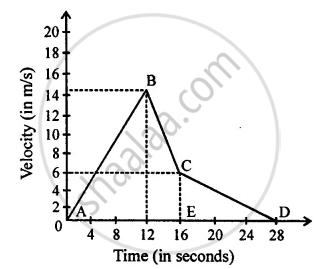
From the velocity – time graph given below, calculate deceleration in region BC.
A cyclist driving at 36 kmh−1 stops his motion in 2 s, by the application of brakes. Calculate
- retardation
- distance covered during the application of brakes.
Define acceleration.
A body falls towards the earth. Does it have positive or negative acceleration?
Write the SI unit of retardation.
A car traveling at 60 km/h, stops on applying brakes in 10 seconds. What is its acceleration?
Out of energy and acceleration, which one is a vector?
What happens to the stepwise increasing speed-time graph when the size of each step is made very small?
Figure represents graphically the velocity of a car moving along a straight road over a period of 100 hours.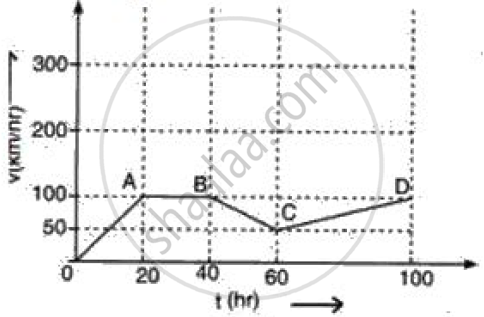
Calculate the acceleration along AB and the retardation along BC.
A car starts from rest and it is travelling with a velocity of 20 m/s in 10 s. What is its acceleration?
What is meant by negative acceleration?
If a body starts from rest, what can be said about the acceleration of the body?
Assertion: Position-time graph of a stationary object is a straight line parallel to the time axis.
Reason: For a stationary object, the position does not change with time.
What is the difference between uniform acceleration and non–uniform acceleration?
When a body is said to be in
- uniform acceleration
- non–uniform acceleration?
