Advertisements
Advertisements
प्रश्न
An object of mass 16 kg is moving with an acceleration of 3 m/s2. Calculate the applied force. If the same force is applied to an object of mass 24 kg, how much will be the acceleration?
Advertisements
उत्तर
Given: m1 = 16 kg, a1 = 3 m/s2, m2 = 24 kg
Find: a2 = ?, F = ?
Applied force, F = m1a1 = 16 kg × 3 m/s2 = 48 N
∴ F = m2a2
∴ Acceleration, `"a"_2 = "F"/"m"_2`
`= (48 "N")/(24 "kg")`
= 2 m/s2
APPEARS IN
संबंधित प्रश्न
Give a scientific reason.
When an object falls freely to the ground, its acceleration is uniform.
Define the term acceleration due to gravity. State its average value.
If a body is moving with a constant velocity its acceleration is ______.
Explain the following concept in your own words with everyday examples:
Acceleration
A ball is rolling from A to D on a flat and smooth surface. Its speed is 2 cm/s. On reaching B, it was pushed continuously up to C. On reaching D from C, its speed had become 4 cm/s. It took 2 seconds for it to go from B to C. What is the acceleration of the ball as it goes from B to C?

State its value in C.G.S. as well as in S.I. system.
A cyclist driving at 5 ms−1, picks a velocity of 10 ms−1, over a distance of 50 m. Calculate
- acceleration
- time in which the cyclist picks up above velocity.
The acceleration of a moving body is constant in magnitude and direction. Must the path of the body be a straight line?
If not, given an example.
What does a positive acceleration mean?
The speed of a car increases from 10 km/h to 64 km/h in 10 seconds. What will be its acceleration?
The distance covered by a body is directly proportional to the square of the time elapsed. What can you say about its acceleration?
Is it possible for an accelerating body to have constant speed?
Sketch the shape of the velocity-time graph for a body moving with:
Uniform acceleration.
Convert the following acceleration:
7200 km/h2 into m/s2
The graph shows how the velocity of a scooter varies with time in 50 s.
Work out: Acceleration.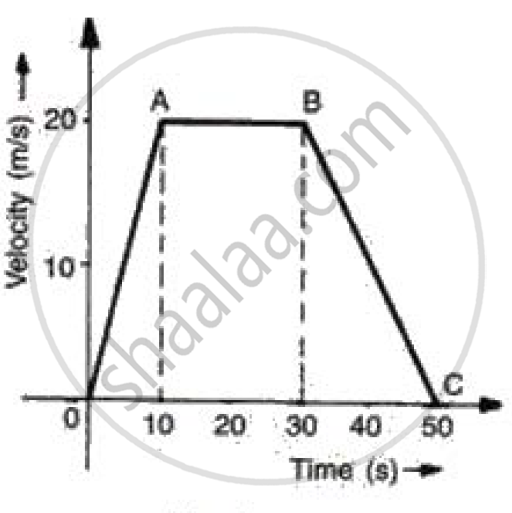
When a body starts from rest, the acceleration of the body after 2 seconds in ______ of its displacement.
If a body starts from rest, what can be said about the acceleration of the body?
Assertion: When a body is subjected to a uniform acceleration, it is always moving in a straight line.
Reason: Motion may be straight-line motion or circular motion.
When a body is said to be in
- uniform acceleration
- non–uniform acceleration?
