Advertisements
Advertisements
प्रश्न
A farmer moves along the boundary of a square field of side 10 m in 40 s. What will be the magnitude of displacement of the farmer at the end of 2 minutes 20 seconds?
Advertisements
उत्तर
Given side of square field = 10m
Then the perimeter of that square field = 4 × 10
= 40m
Total time = 2 minute 20 sec
= (2 × 60 + 20)
= 140 sec
Hence, the distance covered in going around the square field = perimeter of the field
Total distance covered in 40 sec = 40m
Total distance covered in 140 sec = `(40/40) xx140` m
= 140 m
This number of rounds = `140/40`
= 3.5
In 140 sec, that farmer will take 3.5 rounds.
Displacement = Diagonal of square = `(102+102) 1/2`
= `(200)1/2`
= `10sqrt2` m
Hence, magnitude of displacement = `10sqrt2` m
संबंधित प्रश्न
Is displacement a scalar quantity ?
What can you say about the nature of motion of a body if its displacement-time graph is A straight line inclined to the time axis with an acute angle?
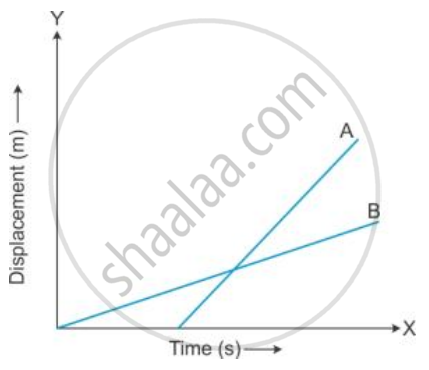
Figure shows the displacement-time graph of two vehicles A and B moving along a straight road. Which vehicle is moving faster? Give reason.
Draw a velocity-time graph for a body moving with an initial velocity u and uniform acceleration a. Use this graph to find the distance travelled by the body in time t.
A body is moving along a circular path of radius r. What will be the distance and displacement of the body when it completes:
Full revolution
A particle moves along a circular path. How many times does it change its direction in two complete rounds?
The table below shows the distance travelled by two vehicles A and B during each second:
| Time (s) | 0 | 1 | 2 | 3 | 4 | 5 | 6 | 7 |
| Distance travelled by A (m) | 0 | 20 | 80 | 180 | 240 | 300 | 360 | 420 |
| Distance travelled by B (m) | 0 | 10 | 40 | 90 | 160 | 250 | 360 | 490 |
Which vehicle is moving with uniform velocity?
Which of the following is correct?
A body moves is a circle of radius ‘2R’ what is the distance covered and displacement of the body after 2 complete rounds?
A particle is moving in a circular pattern of radius r. The displacement after half a circle would be ______.
