Advertisements
Advertisements
प्रश्न
A particle is moving in a circular path of radius r. The displacement after half a circle would be
विकल्प
Zero
R
2r
r/2
Advertisements
उत्तर
2r
APPEARS IN
संबंधित प्रश्न
If on a round trip you travel 6 km and then arrive back home :
What distance have you travelled ?
A body travels a distance of 3 km towards East, then 4 km towards North and finally 9 km towards East.
What is the total distance travelled ?
What can you say about the nature of motion of a body if its displacement-time graph is A straight line inclined to the time axis with an obtuse angle?
Figure (a) shows the velocity-time graph for the motion of a body. Use it to find the displacement of the body at t = 1 s, 2 s, 3 s and 4 s, then draw on Figure (b), the displacement-time graph for it.
 |
 |
| (a) | (b) |
Figure shows the velocity-time graph of a particle moving in a straight line.
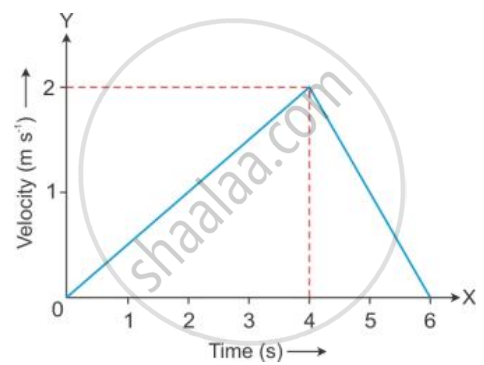
(i) State the nature of motion of particle.
(ii) Find the displacement of particle at t = 6 s.
(iii) Does the particle change its direction of motion?
(iv) Compare the distance travelled by the particle from 0 to 4 s and from 4 s to 6 s.
(v) Find the acceleration from 0 to 4 s and retardation from 4 s to 6 s.
A car travels a distance 100 m with constant acceleration and average velocity of 20 ms-1. The final velocity acquired by the car is 25 ms-1.
Find
(i) The initial velocity.
(ii) Acceleration of the car.
Give an example of a body which covers a certain distance, but its displacement is zero.
Can you suggest the kind of motion of a body from the following distance – time graph?
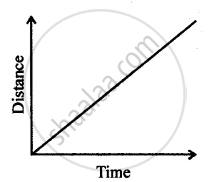
Can distance covered by a body be less than the magnitude of its displacement?
Give the name of the physical quantity that corresponds to the rate of change of displacement.
