Advertisements
Advertisements
प्रश्न
A car starts from rest and moves along the x-axis with constant acceleration 5 ms–2 for 8 seconds. If it then continues with constant velocity, what distance will the car cover in 12 seconds since it started from the rest?
Advertisements
उत्तर
For constant acceleration of car,
u = 0, a = 5 ms−2, t = 8 s
using s = `"ut" + 1/2 "at"^2`, we get
s1 = `0 + 1/2 xx 5 xx 8^2`
= 160 m
For constant velocity of car,
v = u + at
= 0 + 5 × 8
= 40 ms−1
t = (12 − 8) s = 4 s, a = 0
∴ s2 = vt
= 40 × 4
= 160 m
There fore, total distance covered in 12 s
= s1 + s2
= 160 + 160
= 320 m
APPEARS IN
संबंधित प्रश्न
A train takes 3 h to travel from Agra to Delhi with a uniform speed of 65 km h-1. Find the distance between the two cities.
What can you say about the nature of motion of a body if its displacement-time graph is A straight line inclined to the time axis with an obtuse angle?
Figure given below shows a velocity-time graph for a car starting from rest. The graph has three parts AB, BC and CD.
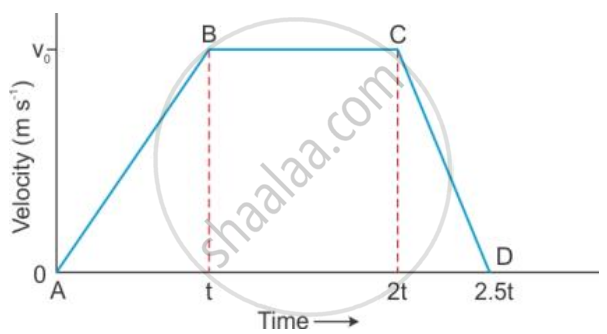
State how is the distance travelled in any part determined from this graph .
How can you find the following?
Velocity from a displacement – time graph.
A motor car slows down from 72 kmh−1 to 36 kmh−1 over a distance of 25 m. If the brakes are applied with the same force
calculate
- total time in which car comes to rest
- distance travelled by it.
Define displacement.
Write two differences between distance and displacement.
Four cars A, B, C, and D are moving on a levelled road. Their distance versus time graphs are shown in Fig. 8.2. Choose the correct statement.

______ is the length of the actual path covered by a body.
Write a note on the following:
knot
