Advertisements
Advertisements
प्रश्न
Match the following.
| 1. | Displacement | Knot |
| 2. | Light travelling through vacuum | Geometric centre |
| 3. | Speed of ship | Metre |
| 4. | Centre of gravity of geometrical shaped objects | Larger base area |
| 5. | Stability | Uniform velocity |
Advertisements
उत्तर
| 1. | Displacement | Metre |
| 2. | Light travelling through vacuum | Uniform velocity |
| 3. | Speed of ship | Knot |
| 4. | Centre of gravity of geometrical shaped objects | Larger base area |
| 5. | Stability | Geometric centre |
APPEARS IN
संबंधित प्रश्न
A boy walks from his classroom to the bookshop along a straight corridor towards North. He covers a distance of 20 m in 25 seconds to reach the bookshop. After buying a book, he travels the same distance in the same time to reach back in the classroom. Find (a) average speed, and (b) average velocity, of the boy.
Give an example of a body which covers a certain distance, but its displacement is zero.
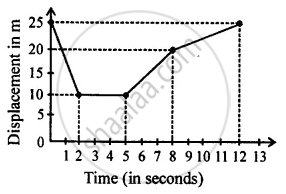
From the displacement – time graph shown given below calculate :
- Velocity between 0 – 2 s.
- Velocity between 8 s – 12 s.
- Average velocity between 5 s – 12 s.
A particle is moving in a circular path of radius r. The displacement after half a circle would be
Exercise Problems.
An athlete completes one round of a circular track of diameter 200 m in 40 s. What will be the distance covered and the displacement at the end of 2 m and 20 s?
Distance travelled by a body in a given time ______.
Is displacement a scalar quantity?
Write a note on the following:
Nautical mile
Slope of a velocity-time graph gives
Using the following data, draw time - displacement graph for a moving object:
| Time (s) | 0 | 2 | 4 | 6 | 8 | 10 | 12 | 14 | 16 |
| Displacement (m) | 0 | 2 | 4 | 4 | 4 | 6 | 4 | 2 | 0 |
Use this graph to find average velocity for the first 4 s, for the next 4 s and for the last 6 s.
