Advertisements
Advertisements
प्रश्न
Match the following.
| 1. | Displacement | Knot |
| 2. | Light travelling through vacuum | Geometric centre |
| 3. | Speed of ship | Metre |
| 4. | Centre of gravity of geometrical shaped objects | Larger base area |
| 5. | Stability | Uniform velocity |
Advertisements
उत्तर
| 1. | Displacement | Metre |
| 2. | Light travelling through vacuum | Uniform velocity |
| 3. | Speed of ship | Knot |
| 4. | Centre of gravity of geometrical shaped objects | Larger base area |
| 5. | Stability | Geometric centre |
APPEARS IN
संबंधित प्रश्न
A boy walks from his classroom to the bookshop along a straight corridor towards North. He covers a distance of 20 m in 25 seconds to reach the bookshop. After buying a book, he travels the same distance in the same time to reach back in the classroom. Find (a) average speed, and (b) average velocity, of the boy.
If the displacement of an object is proportional to the square of time, then the object is moving with :
A train takes 3 h to travel from Agra to Delhi with a uniform speed of 65 km h-1. Find the distance between the two cities.
A body starts with an initial velocity of 10m s-1 and acceleration 5 m s-2. Find the distance covered by it in 5 s.
Define Displacement.
Copy the following table and fill in the blank spaces.
| Quantity | S.I. Unit | Scalar or Vector |
| Displacement | ___________ | ___________ |
A car covers 90 km in `1 1/2` hours towards east. Calculate
- displacement of car,
- its velocity in (a) kmh−1 (b) ms−1.
Calculate the distance and displacement in the following case: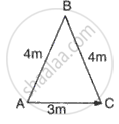
A satellite makes a complete round along its circular orbit. What is its displacement?
Geetha takes 15 minutes from her house to reach her school on a bicycle. If the bicycle has a speed of 2 m/s, calculate the distance between her house and the school.
