Advertisements
Advertisements
प्रश्न
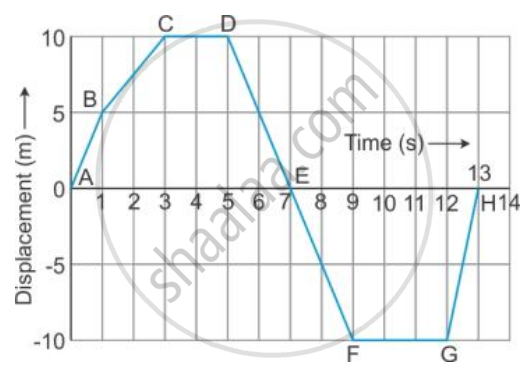
From the displacement-time graph of a cyclist given below in the Figure, find The displacement from the initial position at the end of 10 s,
Advertisements
उत्तर
Initial position = 0 m
Final position at the end of 10 s = -10m
Displacement = Final position - Initial position
= (-10) m - 0
= -10 m
APPEARS IN
संबंधित प्रश्न
State whether distance is a scalar or a vector quantity.
Can displacement-time sketch be parallel to the displacement axis? Give a reason to your answer.
A car covers 90 km in `1 1/2` hours towards east. Calculate
- displacement of car,
- its velocity in (a) kmh−1 (b) ms−1.
Ashok starts from his house and travels 3 km to reach his school. On finding the school gates closed, he returns to his house. What is?
The displacement of Ashok
State whether true or false. If false, correct the statement.
Distance covered by a particle never becomes zero but displacement becomes zero.
Distance travelled by a body in a given time ______.
Four cars A, B, C, and D are moving on a levelled road. Their distance versus time graphs are shown in Fig. 8.2. Choose the correct statement.

______ is the length of the actual path covered by a body.
Give some examples for vector quantity.
The displacement covered by the second hand of radius V in a clock after one revolution is ______.
