Advertisements
Advertisements
Question
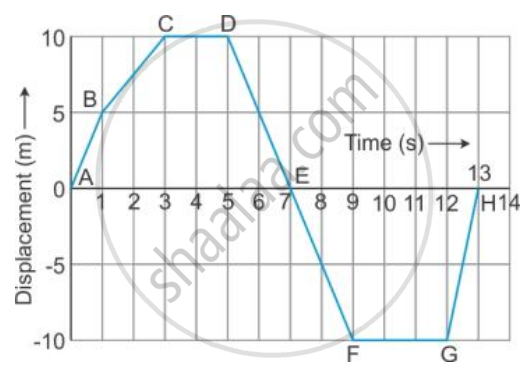
From the displacement-time graph of a cyclist given below in the Figure, find The displacement from the initial position at the end of 10 s,
Advertisements
Solution
Initial position = 0 m
Final position at the end of 10 s = -10m
Displacement = Final position - Initial position
= (-10) m - 0
= -10 m
APPEARS IN
RELATED QUESTIONS
Copy the following table and fill in the blank spaces.
| Quantity | S.I. Unit | Scalar or Vector |
| Displacement | ___________ | ___________ |
A body is moving along a circular path of radius r. What will be the distance and displacement of the body when it completes:
`(3/4)` th of a revolution
Give the name of the physical quantity that corresponds to the rate of change of displacement.
Which of the following figures represent uniform motion of a moving object correctly?
Give one example where the displacement is zero but the distance travelled is not zero.
Write a note on the following:
knot
In which of the following cases of motions, the distance moved and the magnitude of displacement are equal?
The displacement of a moving object in a given interval of time is zero. Would the distance travelled by the object also be zero? Justify your answer.
A scalar quantity has ______.
Choose the correct option.
