Advertisements
Advertisements
प्रश्न
Draw a velocity-time graph for a body moving with an initial velocity u and uniform acceleration a. Use this graph to find the distance travelled by the body in time t.
Advertisements
उत्तर

In this graph, initial velocity = u
Velocity at time t = v
Let acceleration be 'a'
Time = t
Then, distance travelled by the body in t s = area between the v-t graph and X-axis
Or distance travelled by the body in t s = area of the trapezium OABD
= (1/2) × (sum of parallel sides) × (perpendicular distance between them)
= (1/2) × (u + v) × (t)
= (u + v)t /2
APPEARS IN
संबंधित प्रश्न
Under what conditions can a body travel a certain distance and yet its resultant displacement be zero ?
Is displacement a scalar quantity?
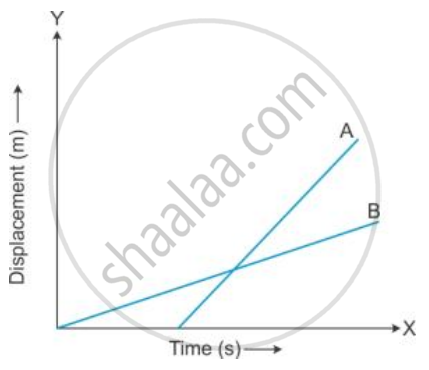
Figure shows the displacement-time graph of two vehicles A and B moving along a straight road. Which vehicle is moving faster? Give reason.
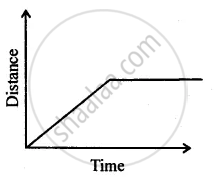
Can you suggest the kind of motion of a body from the following distance – time graph?
A car travels at a uniform speed of 42 km/h. In 10 minutes, how much distance would it cover?
The graph shows how the velocity of a scooter varies with time in 50 s.
Work out: The distance traveled in 10 s, 20 s, and 50 s.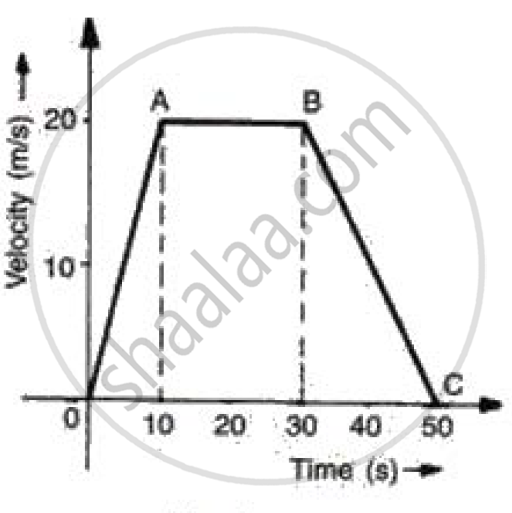
Assertion: Displacement of a body may be zero when distance travelled by it is not zero.
Reason: The displacement is the shortest distance between initial and final position.
Using the following data, draw time - displacement graph for a moving object:
| Time (s) | 0 | 2 | 4 | 6 | 8 | 10 | 12 | 14 | 16 |
| Displacement (m) | 0 | 2 | 4 | 4 | 4 | 6 | 4 | 2 | 0 |
Use this graph to find average velocity for the first 4 s, for the next 4 s and for the last 6 s.
Displacement is the ______ distance covered by a body.
Displacement magnitude can be greater than the distance traveled by the object.
