Advertisements
Advertisements
Question
Draw a velocity-time graph for a body moving with an initial velocity u and uniform acceleration a. Use this graph to find the distance travelled by the body in time t.
Advertisements
Solution

In this graph, initial velocity = u
Velocity at time t = v
Let acceleration be 'a'
Time = t
Then, distance travelled by the body in t s = area between the v-t graph and X-axis
Or distance travelled by the body in t s = area of the trapezium OABD
= (1/2) × (sum of parallel sides) × (perpendicular distance between them)
= (1/2) × (u + v) × (t)
= (u + v)t /2
APPEARS IN
RELATED QUESTIONS
When is the magnitude of displacement equal to the distance?
What can you say about the nature of motion of a body if its displacement-time graph is A straight line inclined to the time axis with an obtuse angle?
Figure (a) shows the velocity-time graph for the motion of a body. Use it to find the displacement of the body at t = 1 s, 2 s, 3 s and 4 s, then draw on Figure (b), the displacement-time graph for it.
 |
 |
| (a) | (b) |
A car covers 90 km in `1 1/2` hours towards east. Calculate
- displacement of car,
- its velocity in (a) kmh−1 (b) ms−1.
How can you find the following?
Velocity from a displacement – time graph.
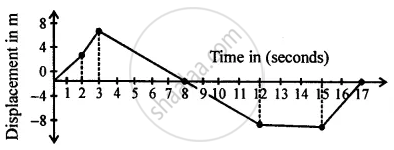
From the displacement – time graph shown given below calculate:
- Average velocity in the first three seconds.
- Displacement from the initial position at the end of 13 s.
- Time after which the body is at the initial position,
- Average velocity after 8 s.
A particle is moving in a circular path of radius r. The displacement after half a circle would be
A car starts from rest and moves along the x-axis with constant acceleration 5 ms–2 for 8 seconds. If it then continues with constant velocity, what distance will the car cover in 12 seconds since it started from the rest?
A man leaves his house at 6.30 a.m. for a morning walk and returns back at 7.30 a.m. after covering 4 km. The Displacement covered by him is ______.
Distance travelled by a freely falling body is proportional to ______.
