Advertisements
Advertisements
Question
A car accelerates to a velocity of 30 m/s in 10 s and then decelerates for 20 s so that it stops. Draw a velocity-time graph to represent the motion and find:
The acceleration.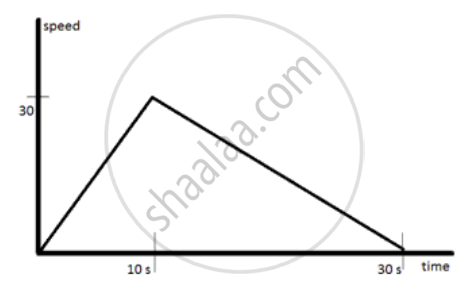
Advertisements
Solution

Acceleration a= (v - u)/t= (30 - 0)/ 10 = 3 ms-2
APPEARS IN
RELATED QUESTIONS
Distinguish between acceleration and retardation.
Figure given below shows a velocity-time graph for a car starting from rest. The graph has three parts AB, BC and CD.
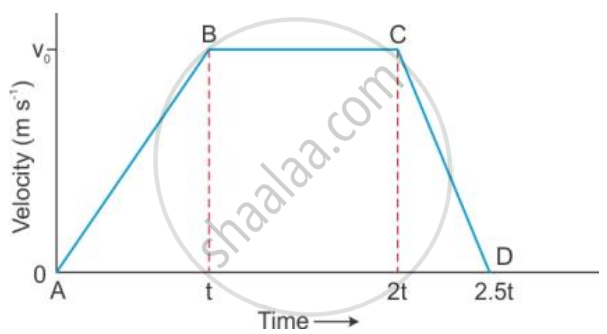
Which part of graph shows motion with uniform
(a) velocity (b) acceleration (c) retardation ?
A vehicle is accelerating on a straight road. Its velocity at any instant is 30 km/h. After 2 s, it is 33.6 km/h, and after further 2 s, it is 37.2 km/h. Find the acceleration of the vehicle in m s-2. Is the acceleration uniform?
Give an example of an accelerated body, moving with a uniform speed.
Draw velocity – time graph for the following situation:
When a body is moving with variable velocity and variable acceleration.
Distinguish between uniformly and non-uniformly accelerated motions.
Can you use the relation [B1]?
The graph shows how the velocity of a scooter varies with time in 50 s.
Work out: Acceleration.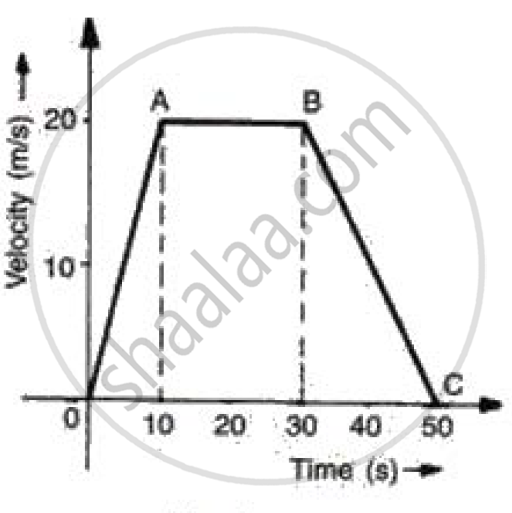
A car accelerates to a velocity of 30 m/s in 10 s and then decelerates for 20 s so that it stops. Draw a velocity-time graph to represent the motion and find:
The Deceleration.
A car accelerates to a velocity of 30 m/s in 10 s and then decelerates for 20 s so that it stops. Draw a velocity-time graph to represent the motion and find:
Distance travelled
