Advertisements
Advertisements
प्रश्न
A car accelerates to a velocity of 30 m/s in 10 s and then decelerates for 20 s so that it stops. Draw a velocity-time graph to represent the motion and find:
The acceleration.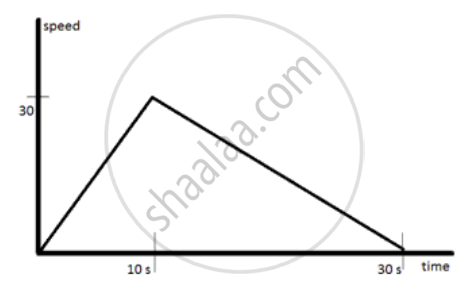
Advertisements
उत्तर

Acceleration a= (v - u)/t= (30 - 0)/ 10 = 3 ms-2
APPEARS IN
संबंधित प्रश्न
Figure given below shows a velocity-time graph for a car starting from rest. The graph has three parts AB, BC and CD.
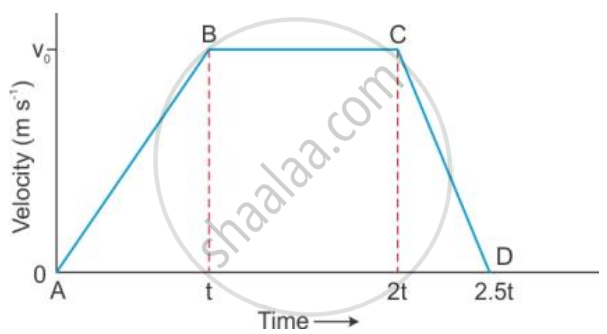
Which part of graph shows motion with uniform
(a) velocity (b) acceleration (c) retardation ?
A bullet initially moving with a velocity 20 m/s strikes a target and comes to rest after penetrating a distance 10 cm into the target. Calculate the retardation caused by the target.
If a body is moving with a constant velocity its acceleration is ______.
A ball is rolling from A to D on a flat and smooth surface. Its speed is 2 cm/s. On reaching B, it was pushed continuously up to C. On reaching D from C, its speed had become 4 cm/s. It took 2 seconds for it to go from B to C. What is the acceleration of the ball as it goes from B to C?

From the diagram given below, calculate deceleration.
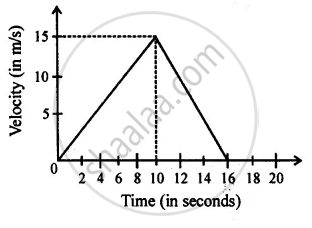
The acceleration of a body is 8.5 ms-2. What does this statement mean?
Write the SI unit of retardation.
The distance covered by a body is directly proportional to the square of the time elapsed. What can you say about its acceleration?
The rate of change of velocity is ______.
Assertion: Position-time graph of a stationary object is a straight line parallel to the time axis.
Reason: For a stationary object, the position does not change with time.
