Advertisements
Advertisements
प्रश्न
A car accelerates to a velocity of 30 m/s in 10 s and then decelerates for 20 s so that it stops. Draw a velocity-time graph to represent the motion and find:
The acceleration.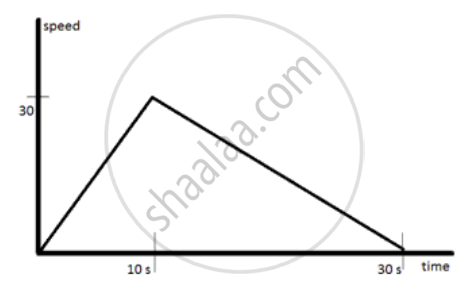
Advertisements
उत्तर

Acceleration a= (v - u)/t= (30 - 0)/ 10 = 3 ms-2
APPEARS IN
संबंधित प्रश्न
From the diagram given below, calculate acceleration.
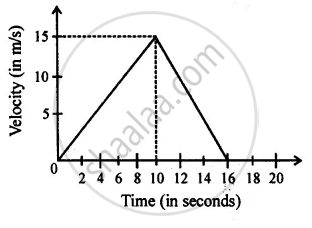
From the diagram given below, calculate deceleration.
A racing car, initially at rest, picks up a velocity of 180 kmh−1 in 4.5 s. Calculate
- acceleration
- distance covered by the car.
What is the SI unit of acceleration?
State if the following situation is possible:
A body moving horizontally with an acceleration in vertical direction.
Assertion: The accelerated motion of an object may be due to change in magnitude of velocity or direction or both of them.
Reason: Acceleration can be produced only by change in magnitude of the velocity. It does not depend the direction.
If a body starts from rest, what can be said about the acceleration of the body?
An object can be moving with uniform speed but with variable acceleration.
It is possible to have objects moving with uniform speed but variable acceleration.
