Advertisements
Advertisements
प्रश्न
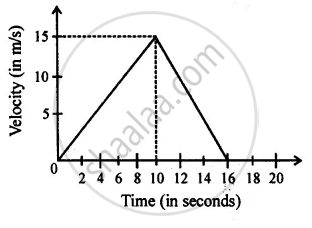
From the diagram given below, calculate acceleration.
Advertisements
उत्तर
Acceleration = Slope of v.t. graph from O to A
= `"AC"/"OC"=15/10` = 1.5 m/s2
APPEARS IN
संबंधित प्रश्न
Figure shows the velocity-time graphs for two cars A and B moving in the same direction. Which car has greater acceleration? Give reasons to your answer.
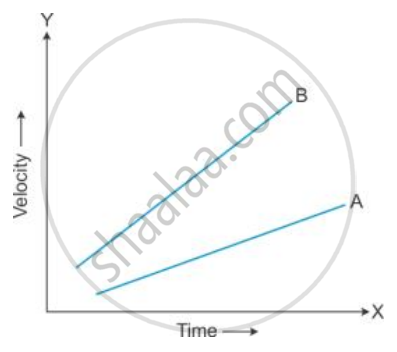
Figure given below shows a velocity-time graph for a car starting from rest. The graph has three parts AB, BC and CD.
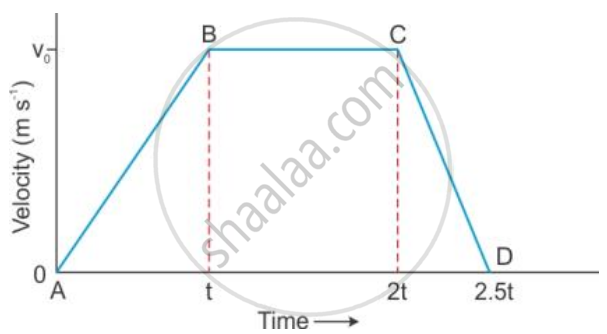
(a) Is the magnitude of acceleration higher or lower than that of retardation ? Give a reason .
(b) Compare the magnitude of acceleration and retardation .
A bullet initially moving with a velocity 20 m/s strikes a target and comes to rest after penetrating a distance 10 cm into the target. Calculate the retardation caused by the target.
A motor bike running at 90 kmh−1 is slowed down to 18 kmh−1 in 2.5 s. Calculate
- acceleration
- distance covered during slow down.
Write the SI unit of acceleration and retardation.
Sketch the shape of the velocity-time graph for a body moving with:
Uniform acceleration.
Convert the following acceleration:
7200 km/h2 into m/s2
Figure represents graphically the velocity of a car moving along a straight road over a period of 100 hours.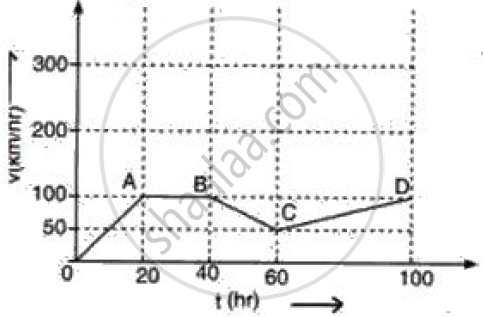
Calculate the acceleration along AB and the retardation along BC.
Exercise Problem.
A racing car has a uniform acceleration of 4 ms–2. What distance it covers in 10 s after the start?
The value of acceleration for a body at rest is ______.
