Advertisements
Advertisements
प्रश्न
The rate of change of velocity is ______.
Advertisements
उत्तर
The rate of change of velocity is acceleration.
APPEARS IN
संबंधित प्रश्न
Give one example of the following motion:
Uniform retardation
A toy car initially moving with uniform velocity of 18 km h-1 comes to a stop in 2 s. Find the retardation of the car in S.I. units.
State the type of motion represented by the following sketches in Figures.
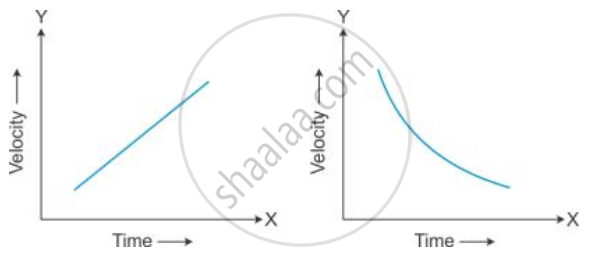
Give an example of each type of motion.
Explain the following concept in your own words with everyday examples:
Acceleration
When is the acceleration due to gravity positive?
Diagram is given below shows velocity – time graph of car P and Q, starting from the same place and in the same direction. Calculate the Acceleration of car P.
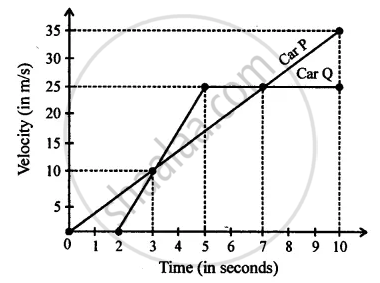
Diagram is given below shows velocity – time graph of car P and Q, starting from the same place and in the same direction. Calculate the Acceleration of car Q between 2 s – 5 s.
A cyclist driving at 5 ms−1, picks a velocity of 10 ms−1, over a distance of 50 m. Calculate
- acceleration
- time in which the cyclist picks up above velocity.
A motor bike running at 5 ms−1, picks up a velocity of 30 ms−1 in 5s. Calculate
- acceleration
- distance covered during acceleration.
The initial velocity of a car is 10 ms-1. It moves with an acceleration of 2 ms-2. What will be its speed after 10 seconds?
A body has an acceleration of -3.5 ms-2. What is its retardation?
A car accelerates uniformly from a velocity of 18 km/h to 36 km/h in 15 min. What is its acceleration?
The graph shows how the velocity of a scooter varies with time in 50 s.
Work out: Deceleration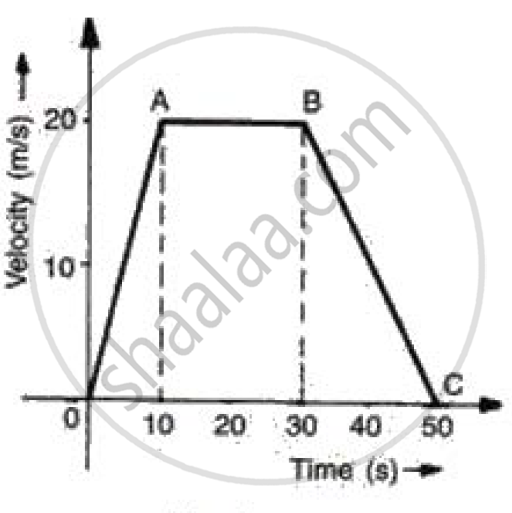
From the given v-t graph it can be inferred that an object is

What do you understand about negative acceleration?
The acceleration of the body that moves with a uniform velocity will be ______.
What is meant by negative acceleration?
A car is being driven at a speed of 20ms-1 when brakes are applied to bring it to rest in 5 s. The deceleration produced in this case will be ______.
Assertion: A negative acceleration of a body can be associated with speeding up of the body.
Reason: Increase in the speed of a moving body is independent of its direction of motion.
