Advertisements
Advertisements
प्रश्न
The rate of change of velocity is ______.
Advertisements
उत्तर
The rate of change of velocity is acceleration.
APPEARS IN
संबंधित प्रश्न
Define acceleration. State its unit.
Draw a graph for acceleration against time for a uniformly accelerated motion. How can it be used to find the change in speed in a certain interval of time?
A vehicle is accelerating on a straight road. Its velocity at any instant is 30 km/h. After 2 s, it is 33.6 km/h, and after further 2 s, it is 37.2 km/h. Find the acceleration of the vehicle in m s-2. Is the acceleration uniform?
Explain the following concept in your own words with everyday examples:
Acceleration
Draw velocity – time graph for the following situation:
When a body is moving with variable velocity and variable acceleration.
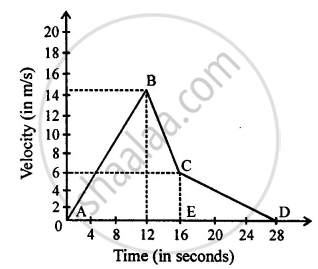
From the velocity – time graph given below, calculate deceleration in region BC.
Write the SI unit of retardation.
State if the following situation is possible:
A body moving with constant acceleration but with Zero velocity.
Is it possible for an accelerating body to have constant speed?
Interpret the following graph: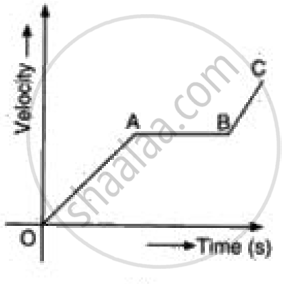
The graph shows how the velocity of a scooter varies with time in 50 s.
Work out: Deceleration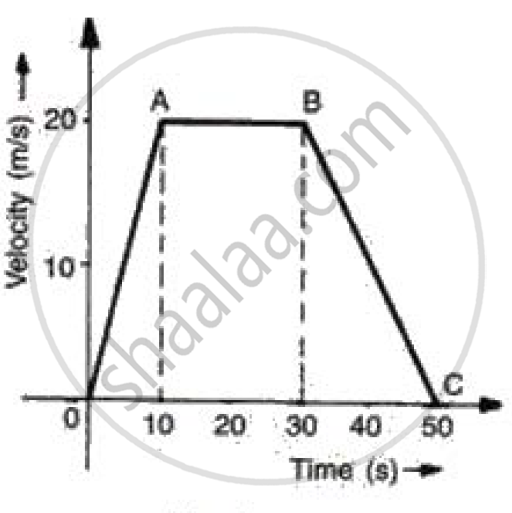
Correct your friend who says that acceleration gives the idea of how fast the position changes.
A bus can accelerate with an acceleration of 1 m/s2 . Find the minimum time for the bus to attain the speed of 100 km/s from 50 km /s.
Negative acceleration is called ______.
When a body starts from rest, the acceleration of the body after 2 seconds in ______ of its displacement.
A bus accelerating with 4ms-2 changes its speed from 60ms_1 to a certain value in 5s. The final speed is ______.
If a body starts from rest, what can be said about the acceleration of the body?
Assertion: When a body is subjected to a uniform acceleration, it is always moving in a straight line.
Reason: Motion may be straight-line motion or circular motion.
