Advertisements
Advertisements
प्रश्न
A cyclist driving at 5 ms−1, picks a velocity of 10 ms−1, over a distance of 50 m. Calculate
- acceleration
- time in which the cyclist picks up above velocity.
Advertisements
उत्तर
Initial velocity = u = 5 ms−1
Final velocity = v = 10 ms−1
Distance = S =50 m
(i) v2 – u2 = 2aS
(10)2 – (5)2 = 2a (50)
100 − 25 = 100a
100a = 75
a = `75/100` = 0.75 ms−2
∴ Acceleration = a = 0.75 ms−2
(ii) v = u + at
10 = 5 + 0.75t
0.75t = 10 − 5 = 5
(Time) t = `5/0.75` = 6.67 S
APPEARS IN
संबंधित प्रश्न
Define the term acceleration due to gravity. State its average value.
Give an example of an accelerated body, moving with a uniform speed.
The change in velocity of a motorbike is 54 kmh−1 in one minute. Calculate its acceleration in (a) ms−2 (b) kmh−2.
From the velocity – time graph given below, calculate deceleration in region BC.
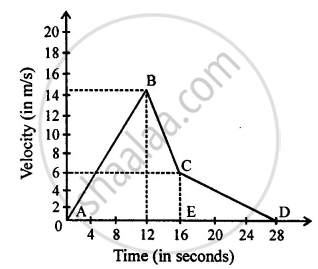
Define acceleration.
State if the following situation is possible:
A body moving with constant acceleration but with Zero velocity.
Figure represents graphically the velocity of a car moving along a straight road over a period of 100 hours.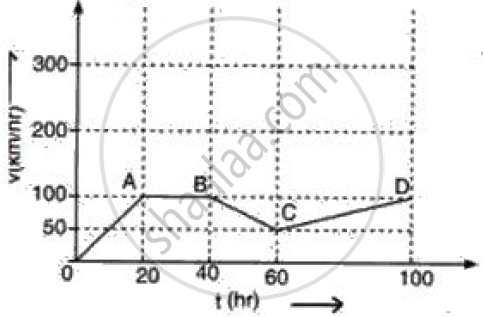
Calculate the acceleration along AB and the retardation along BC.
Assertion: The accelerated motion of an object may be due to change in magnitude of velocity or direction or both of them.
Reason: Acceleration can be produced only by change in magnitude of the velocity. It does not depend the direction.
When an object undergoes acceleration ______.
A quantity has a value of 16ms-2. It is the ______.
