Advertisements
Advertisements
प्रश्न
A car accelerates uniformly from a velocity of 18 km/h to 36 km/h in 15 min. What is its acceleration?
Advertisements
उत्तर
Initial velocity of car u = 18 km/hr.
Final velocity of car v= 36 km/hr.
Time taken by body = 15 min. = 1/4 hr
Acceleration of car a = ( v- u )/t = (36 - 18 ) X 4 = 72 kmh-2.
APPEARS IN
संबंधित प्रश्न
Distinguish between acceleration and retardation.
Give one example of the following motion:
Uniform retardation
A body is moving vertically upwards. Its velocity changes at a constant rate from 50 m s−1 to 20 m s−1 in 3 s. What is its acceleration?
Figure given below shows a velocity-time graph for a car starting from rest. The graph has three parts AB, BC and CD.
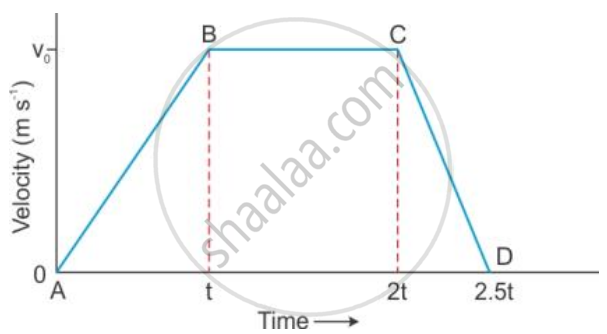
(a) Is the magnitude of acceleration higher or lower than that of retardation ? Give a reason .
(b) Compare the magnitude of acceleration and retardation .
A cyclist driving at 36 kmh−1 stops his motion in 2 s, by the application of brakes. Calculate
- retardation
- distance covered during the application of brakes.
Distinguish between uniformly and non-uniformly accelerated motions.
The distance covered by a body is directly proportional to the square of the time elapsed. What can you say about its acceleration?
State if the following situation is possible:
A body moving with constant acceleration but with Zero velocity.
Assertion: When a body is subjected to a uniform acceleration, it is always moving in a straight line.
Reason: Motion may be straight-line motion or circular motion.
When a body is said to be in
- uniform acceleration
- non–uniform acceleration?
