Advertisements
Advertisements
प्रश्न
Correct your friend who says that acceleration gives the idea of how fast the position changes.
Advertisements
उत्तर
There are two possible answers:
Velocity gives an idea of how fast the position changes, or Acceleration gives an idea of how fast the velocity changes.
APPEARS IN
संबंधित प्रश्न
A ball is rolling from A to D on a flat and smooth surface. Its speed is 2 cm/s. On reaching B, it was pushed continuously up to C. On reaching D from C, its speed had become 4 cm/s. It took 2 seconds for it to go from B to C. What is the acceleration of the ball as it goes from B to C?

State its value in C.G.S. as well as in S.I. system.
When is the acceleration due to gravity negative?
A racing car is moving with a velocity of 50 m/s. On
applying brakes, it is uniformly retarded and comes to rest in 20 seconds. Calculate its acceleration.
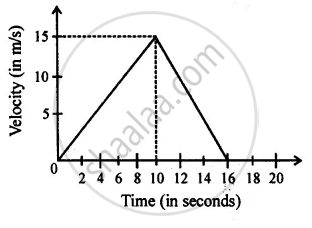
From the diagram given below, calculate acceleration.
A cyclist driving at 5 ms−1, picks a velocity of 10 ms−1, over a distance of 50 m. Calculate
- acceleration
- time in which the cyclist picks up above velocity.
A truck running at 90 kmh−1, is brought to rest over a distance of 25 m. Calculate the retardation and time for which brakes are applied.
A motor bike running at 90 kmh−1 is slowed down to 18 kmh−1 in 2.5 s. Calculate
- acceleration
- distance covered during slow down.
The distance covered by a body is directly proportional to the square of the time elapsed. What can you say about its acceleration?
A car accelerates uniformly from a velocity of 18 km/h to 36 km/h in 15 min. What is its acceleration?
The graph shows how the velocity of a scooter varies with time in 50 s.
Work out: Acceleration.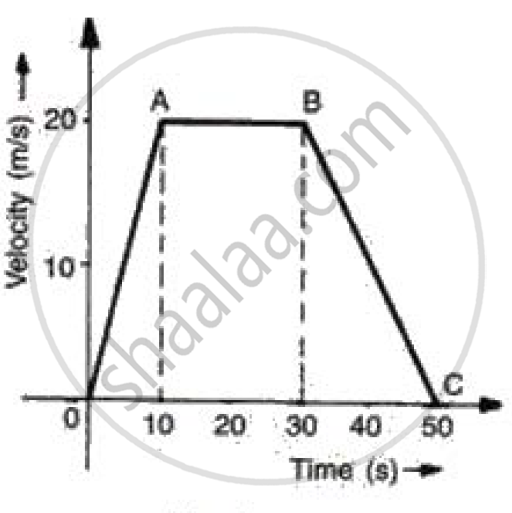
A car accelerates to a velocity of 30 m/s in 10 s and then decelerates for 20 s so that it stops. Draw a velocity-time graph to represent the motion and find:
The Deceleration.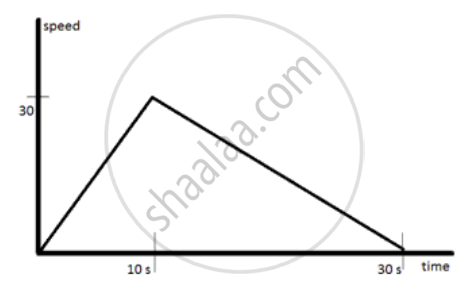
Negative acceleration is called ______.
Assertion: The accelerated motion of an object may be due to change in magnitude of velocity or direction or both of them.
Reason: Acceleration can be produced only by change in magnitude of the velocity. It does not depend the direction.
Exercise Problem.
A racing car has a uniform acceleration of 4 ms–2. What distance it covers in 10 s after the start?
If the velocity of a body does not change, then its acceleration is ______.
When a body starts from rest, the acceleration of the body after 2 seconds in ______ of its displacement.
Acceleration is defined as the rate of change of ______.
A car is being driven at a speed of 20ms-1 when brakes are applied to bring it to rest in 5 s. The deceleration produced in this case will be ______.
