Advertisements
Advertisements
प्रश्न
A circular cycle track has a circumstance of 314 m with AB as one of its diameter. A cyclist travels from A to B along the circular path with a velocity of constant magnitude 15. 7 m/ s. Find :
(a) The distance moved by the cyclist.
(b) The displacement of the cyclist if AB represents north-south direction .
(c) The average velocity of the cyclist.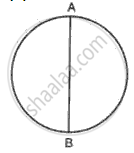
Advertisements
उत्तर
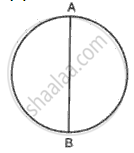
Circumference of track = 314 m.
We know that circumference = 2nr
So 2nr = 314
R = 314/ 2n = 50 m
Diameter of track would be = 2 x 50 = 100 m.
Length of path AB= 100 m.
(a) Distance moved by cyclist= half the circumference of track i.e 314/ 2 = 157 m.
(b) The displacement of cyclist is equal to the diameter of circle i.e AB= 100 m.
(c) Average velocity would be equal to = 15.7 ms-1.
APPEARS IN
संबंधित प्रश्न
When a body said to have a uniform velocity?
Distinguish between speed and velocity.
A body moves in a circular pattern the ______ of velocity does not change but changes.
Distinguish between speed and velocity.
Define velocity.
Distinguish between speed and velocity.
Distinguish between speed and velocity.
Distinguish between speed and velocity.
Distinguish between speed and velocity.
Define velocity.
