Advertisements
Advertisements
Question
A circular cycle track has a circumstance of 314 m with AB as one of its diameter. A cyclist travels from A to B along the circular path with a velocity of constant magnitude 15. 7 m/ s. Find :
(a) The distance moved by the cyclist.
(b) The displacement of the cyclist if AB represents north-south direction .
(c) The average velocity of the cyclist.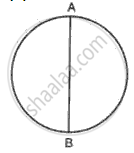
Advertisements
Solution
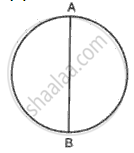
Circumference of track = 314 m.
We know that circumference = 2nr
So 2nr = 314
R = 314/ 2n = 50 m
Diameter of track would be = 2 x 50 = 100 m.
Length of path AB= 100 m.
(a) Distance moved by cyclist= half the circumference of track i.e 314/ 2 = 157 m.
(b) The displacement of cyclist is equal to the diameter of circle i.e AB= 100 m.
(c) Average velocity would be equal to = 15.7 ms-1.
APPEARS IN
RELATED QUESTIONS
A stone is dropped from a certain height. Is its motion uniform or non-uniform?
Assertion: The Speedometer of a car or a motor-cycle measures its average speed.
Reason: Average velocity is equal to total displacement divided by total time taken.
Define velocity.
Exercise Problems.
A ball is gently dropped from a height of 20 m. If its velocity increases uniformly at the rate of 10 ms–2, with what velocity will it strike the ground? After what time will it strike the ground?
A body moves with an initial velocity of 5ms-1 and accelerates at 2ms -2. Its velocity after 10s is ______.
At the highest point, when a body is thrown vertically upwards, the velocity is ______.
Distinguish between speed and velocity.
Distinguish between speed and velocity.
Define velocity.
Distinguish between Speed and Velocity.
