Advertisements
Advertisements
प्रश्न
An artificial satellite is moving in a circular orbit of radius nearly 42,250 km. Calculate its linear velocity, if it takes 24 hours to revolve round the earth
Advertisements
उत्तर
Radius of orbit is 42250 km.
Distance covered by satellite to complete 1 revolution is 2 πr.
So distance is = 2 X 3.14 X42250 =265330 km.
time taken by satellite to complete one revolution is 24 hr = 24X60X60=86400 sec.
so linear velocity is= distance /time= 265330/86400 ms-1 = 3.07 km s-1.
APPEARS IN
संबंधित प्रश्न
A stone is dropped from a certain height. Is its motion uniform or non-uniform?
A circular cycle track has a circumstance of 314 m with AB as one of its diameter. A cyclist travels from A to B along the circular path with a velocity of constant magnitude 15. 7 m/ s. Find :
(a) The distance moved by the cyclist.
(b) The displacement of the cyclist if AB represents north-south direction .
(c) The average velocity of the cyclist.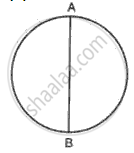
If the velocity of an object increases with respect to time, then the object is said to be in______ acceleration.
Assertion: The Speedometer of a car or a motor-cycle measures its average speed.
Reason: Average velocity is equal to total displacement divided by total time taken.
A car accelerates at 1.5m/s2 on a straight road. How much is the increase in velocity in 4s?
Speed of the body in a particular direction can be called ______.
Define velocity.
Distinguish between speed and velocity.
Distinguish between speed and velocity.
Define velocity.
