Advertisements
Advertisements
प्रश्न
The acceleration of a moving body is constant in magnitude and direction. Must the path of the body be a straight line?
If not, given an example.
Advertisements
उत्तर
If the acceleration of a moving body is constant in magnitude and direction then the path of the body must not be a straight line because in circular motion also acceleration of a body is constant in magnitude and always directed towards the centre.
So the path of the body may be a straight line and may be a circular one.
APPEARS IN
संबंधित प्रश्न
The velocity-time graph for a uniformly retarded body is a straight line inclined to the time axis with an obtuse angle. How is retardation calculated from the velocity-time graph?
A ball is rolling from A to D on a flat and smooth surface. Its speed is 2 cm/s. On reaching B, it was pushed continuously up to C. On reaching D from C, its speed had become 4 cm/s. It took 2 seconds for it to go from B to C. What is the acceleration of the ball as it goes from B to C?

State if the following situation is possible:
A body moving with a constant velocity in an accelerated motion.
Interpret the following graph: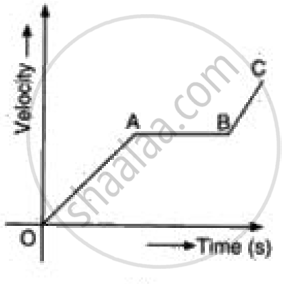
A body has an acceleration of -3.5 ms-2. What is its retardation?
Convert the following acceleration:
1/36 m/s2 into km/h2
A car accelerates to a velocity of 30 m/s in 10 s and then decelerates for 20 s so that it stops. Draw a velocity-time graph to represent the motion and find:
The acceleration.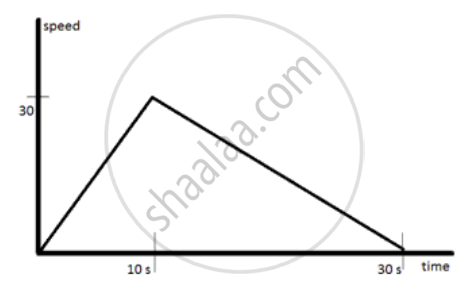
Figure represents graphically the velocity of a car moving along a straight road over a period of 100 hours.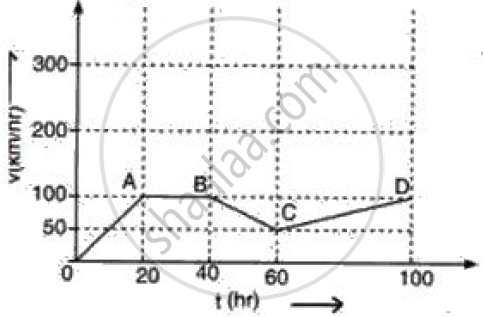
Calculate the acceleration along AB and the retardation along BC.
A quantity has a value of 16ms-2. It is the ______.
A boy throws a ball up and catches it when the ball falls back. In which part of the motion the ball is accelerating?
