Advertisements
Advertisements
प्रश्न
Give a scientific reason.
When an object falls freely to the ground, its acceleration is uniform.
Advertisements
उत्तर
When an object falls freely to the ground, it is under the effect of a constant force known as the force of gravity. No other forces act on it. Hence, from Newton's second law of motion, we can say that this constant force of gravity accelerates the freely falling object uniformly. This uniform acceleration is known as acceleration due to gravity which acts towards the centre and is denoted by g.
APPEARS IN
संबंधित प्रश्न
An object of mass 16 kg is moving with an acceleration of 3 m/s2. Calculate the applied force. If the same force is applied to an object of mass 24 kg, how much will be the acceleration?
A train moving with a velocity of 20 ms−1 is brought to rest by applying brakes in 5 s. Calculate the retardation.
A vehicle is accelerating on a straight road. Its velocity at any instant is 30 km/h. After 2 s, it is 33.6 km/h, and after further 2 s, it is 37.2 km/h. Find the acceleration of the vehicle in m s-2. Is the acceleration uniform?
Give an example of an accelerated body, moving with a uniform speed.
From the velocity – time graph given below, calculate deceleration in region BC.
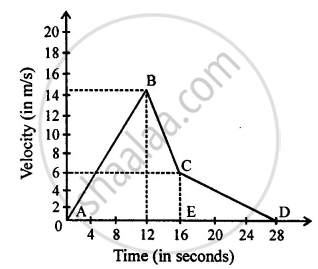
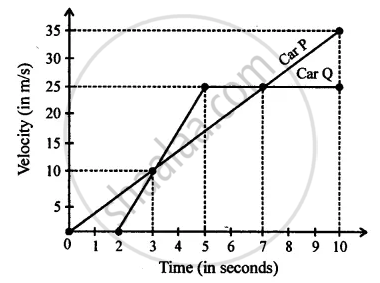
Diagram is given below shows velocity – time graph of car P and Q, starting from the same place and in the same direction. Calculate the Acceleration of car Q between 2 s – 5 s.
An aeroplane lands at 216 kmh−1 and stops after covering a runway of 2 m. Calculate the acceleration and the time, in which it comes to rest.
A racing car, initially at rest, picks up a velocity of 180 kmh−1 in 4.5 s. Calculate
- acceleration
- distance covered by the car.
A motor bike running at 90 kmh−1 is slowed down to 18 kmh−1 in 2.5 s. Calculate
- acceleration
- distance covered during slow down.
Sketch the shape of the velocity-time graph for a body moving with:
Uniform acceleration.
Convert the following acceleration:
1/36 m/s2 into km/h2
The graph shows how the velocity of a scooter varies with time in 50 s.
Work out: Acceleration.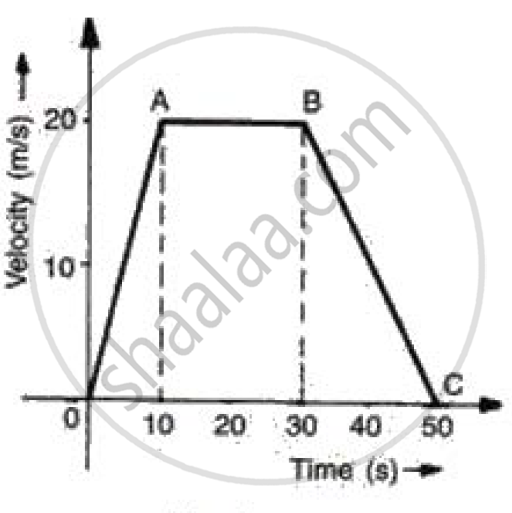
The graph shows how the velocity of a scooter varies with time in 50 s.
Work out: Deceleration
The rate of change of velocity is ______.
Assertion: The accelerated motion of an object may be due to change in magnitude of velocity or direction or both of them.
Reason: Acceleration can be produced only by change in magnitude of the velocity. It does not depend the direction.
The slope of a velocity-time graph gives ______.
A quantity has a value of 16ms-2. It is the ______.
Assertion: A negative acceleration of a body can be associated with speeding up of the body.
Reason: Increase in the speed of a moving body is independent of its direction of motion.
What is the difference between uniform acceleration and non–uniform acceleration?
